A cart abandonment email is what you send to a shopper who put items in their cart but then vanished without buying. It’s your chance to bring them back and recover a sale that would otherwise be gone for good. Think of it as a gentle nudge, a reminder of the great stuff they were just about to get.
Getting to the “Why” Behind Abandoned Carts
It’s tempting to look at an abandoned cart and just see a lost sale. But I’ve learned to see it as a signal. A customer is essentially telling you, “I was this close, but something stopped me.” Figuring out that “something” is the key to creating a recovery strategy that actually works.
The numbers here are staggering—e-commerce brands lose a mind-boggling $18 billion every year from abandoned carts. When you dig into why, a clear pattern emerges. The biggest dealbreaker? Unexpected costs. A full 55% of shoppers walk away because of extra fees like taxes and shipping tacked on at the end. Another 39% point the finger directly at high shipping costs. Trust is also huge; 19% bail because they’re worried about their credit card info.
These aren’t just abstract statistics. They’re telling you exactly what your customers are thinking and feeling at the most critical moment of their purchase journey.
The Psychology of Clicking Away
So, what’s really going through a shopper’s head when they decide to close the tab? It usually comes down to one of these classic moments of friction:
- Sticker Shock: The price they saw on the product page is almost never the final price. When shipping, taxes, and surprise fees pop up at the very last second, it feels like a bait-and-switch. It breaks trust, even if it’s standard procedure.
- Decision Fatigue: Let’s be real, your customers probably have five other tabs open, comparing prices and options. If your checkout is a multi-step saga asking for too much information, you’re making it easy for them to give up and go with a competitor who offers a smoother ride.
- Missing Trust Signals: We’ve all been there. If a site looks a bit sketchy, lacks security badges (like an SSL certificate), or has a confusing return policy, that little voice of doubt gets louder. It’s often enough to make someone abandon a full cart.
To help you diagnose what might be going wrong, here’s a quick rundown of the most common triggers I’ve seen and how to tackle them head-on.
Common Cart Abandonment Triggers and Their Solutions
| Abandonment Reason | Impact on Customer | Actionable Solution |
|---|---|---|
| Unexpected Shipping Costs | Creates “sticker shock” and feels deceptive. The final price is much higher than anticipated. | Offer free shipping thresholds (e.g., “Free shipping on orders over $75”). Display shipping costs upfront on the product or cart page. |
| Complicated Checkout Process | Causes frustration and fatigue. Too many fields or steps make the purchase feel like work. | Enable guest checkout. Simplify your checkout form to only essential fields. Add progress indicators to show how close they are to finishing. |
| Forced Account Creation | Feels like a barrier and an unnecessary commitment. Customers want a quick, seamless experience. | Allow guest checkout as the primary option. Offer the choice to create an account after the purchase is complete for easier future orders. |
| Security Concerns | Instills doubt and fear about personal and financial data being compromised. | Display trust badges (SSL, McAfee, etc.) prominently. Include customer reviews and testimonials. Have a clear, professional-looking design. |
| Better Price Elsewhere | The customer is actively comparison shopping and found a more competitive offer. | Use an exit-intent popup with a small, one-time discount. Highlight your unique value proposition (quality, warranty, customer service). |
| Technical Issues / Website Bugs | Creates a poor user experience, making it impossible or frustrating to complete the purchase. | Regularly test your checkout flow on different devices and browsers. Make sure your site is mobile-optimized and loads quickly. |
Ultimately, understanding these common pain points is the first step. For a deeper dive into other tactics, these Effective Strategies to Reduce Cart Abandonment offer some great insights.
By getting inside your customer’s head, you can stop sending generic “You left something behind!” emails and start crafting messages that solve their specific problems. This not only brings back lost sales but also proves you’re a brand that listens, which is how you build loyalty that lasts.
Building Your Three-Part Email Recovery Sequence
A single abandoned cart email is a decent starting point, but let’s be honest, a multi-part sequence is where the real money is. Think of it less like a one-off message and more like a strategic conversation that unfolds over a few days. The goal is to stay top-of-mind without being a pest, gently guiding shoppers back with increasing value and a touch of urgency.
The classic three-part sequence is an industry standard for a reason: it perfectly mirrors the customer’s mindset after they’ve clicked away.
The journey from adding an item to the cart to that moment of hesitation is a critical funnel for any ecommerce store.
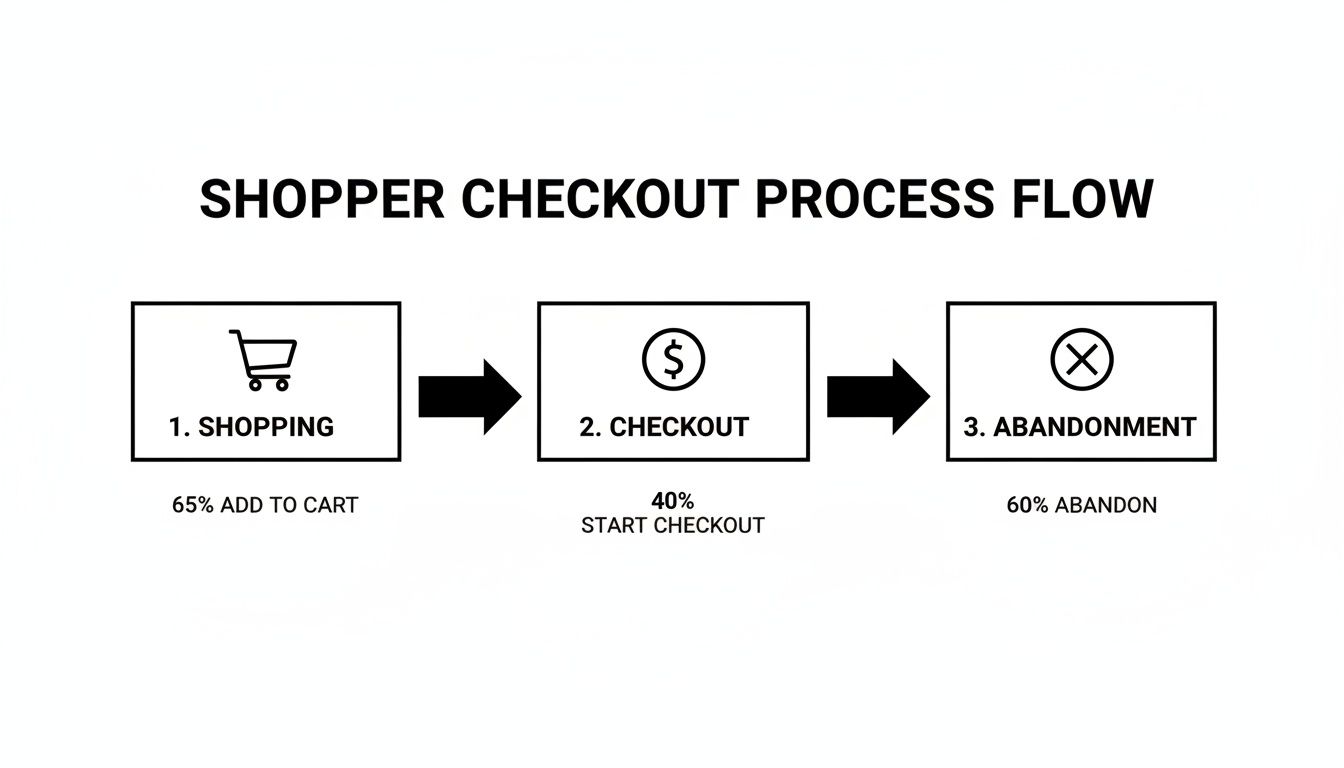
This simple flow chart pinpoints that golden opportunity—the gap between initiating checkout and actual abandonment. This is precisely where your recovery sequence swoops in.
A well-timed, automated follow-up can claw back a serious chunk of otherwise lost revenue. This is where a structured, three-email cadence really proves its worth. To see how this works in practice, check out these marketing automation workflow examples that demonstrate how timed sequences drive results.
Email 1: The Gentle Nudge
This first email needs to go out fast—ideally within the first hour after someone leaves. At this point, the purchase is still fresh in their mind. The reason they left could be anything from a simple distraction like a phone call to a spotty internet connection.
Your goal here isn’t to be pushy; it’s to be helpful. Frame this message as a customer service touchpoint. Did something go wrong? Was there a technical hiccup? You’re just saving their cart for them as a convenience.
- Timing: Send within 60 minutes.
- Tone: Friendly, helpful, and totally low-pressure.
- Message Focus: Think “Did you forget something?” or “We saved your items for you.”
- Offer: Don’t offer a discount yet. The main goal is just to get them back.
- CTA: Use a clear, bold button that says something like “Return to My Cart” or “Complete My Purchase.” Example Subject Line: Still thinking it over?
Example Body Copy: Hi [Customer Name], we noticed you left a few things in your cart. No worries, we’ve saved them for you! Click the link below to pick up right where you left off.
Email 2: The Value-Driven Follow-Up
If the first email didn’t reel them back in, it’s time to sweeten the deal. The second email, which I recommend sending around 24 hours later, assumes the hesitation might be about price or some other barrier. This is your chance to tackle that objection head-on with an incentive they can’t ignore.
This email is more direct. It acknowledges they’re still interested and gives them a solid reason to complete the purchase now. From my experience, this is often the email that gets the highest conversion rate in the whole sequence.
- Timing: Send 24 hours after abandonment.
- Tone: Persuasive and focused on the value you’re adding.
- Message Focus: Address potential roadblocks like cost by introducing a great offer.
- Offer: This is the perfect spot for an incentive. Some popular ones include:
- A percentage discount (10-15% off)
- A fixed-amount discount ($10 off your order)
- Free shipping (This is a huge one—it’s a top reason for abandonment)
- CTA: Make it action-oriented and highlight the benefit, like “Claim Your 15% Off” or “Get Free Shipping.” Example Subject Line: A special offer just for you.
Example Body Copy: Hi [Customer Name], still interested in the items in your cart? To help you decide, here’s 15% off your entire order, on us. This offer is only good for a limited time, so don’t miss out!
Email 3: The Final Friendly Reminder
Your third and final email, sent around the 72-hour mark, is the last chance saloon. The main goal here is to create a bit of urgency. If they haven’t converted after two emails, a final nudge about the offer from Email 2 expiring can be incredibly effective.
You’re not trying to resell them on the product’s value at this point. You’re simply reminding them that the opportunity to buy with that extra perk is about to vanish. The tone should be friendly but firm, tapping into that powerful fear of missing out (FOMO).
- Timing: Send 48-72 hours after abandonment.
- Tone: Urgent, but still helpful.
- Message Focus: “Last chance” or “Your offer is expiring.”
- Offer: Reiterate the discount from the second email and make it clear it’s about to disappear. You can also mention low stock levels if that’s genuinely the case.
- CTA: Use urgent language like “Shop Now Before It’s Gone” or “Use My Discount Now.” Example Subject Line: Your cart (and your discount) expires soon!
Example Body Copy: Hi [Customer Name], this is a final reminder that the items in your cart are waiting for you, but your special 15% discount expires tonight. Don’t let these get away!
By structuring your strategy into this three-part flow, you create multiple, tailored chances to re-engage shoppers and systematically recover sales that would have otherwise been lost for good.
Writing Subject Lines and Copy That Actually Convert
You can have the most perfectly timed cart abandonment sequence on the planet, but it’s all for nothing if the message falls flat. Your subject line is the first handshake in a crowded inbox—it gets a split second to earn the open. The email copy that follows is the real conversation, where you need to rekindle that initial spark and gently guide them back to checkout.
Getting this right isn’t just about stringing words together. It’s a mix of psychology, branding, and pure clarity, all wrapped up in a message that feels personal, not pushy. The goal is to be the most helpful, relevant voice they hear, not the loudest one.
Nailing the Subject Line
Let’s be honest, the subject line is the gatekeeper. Everything else hinges on it. Your approach should shift depending on where the email falls in your sequence and, of course, your brand’s personality.
The First Email: A Gentle Nudge
Here, the vibe is helpful and low-pressure. You’re just trying to spark curiosity and remind them of what they were looking at. Think service, not sales.
- “Did you forget something?”
- “Your cart is waiting for you”
- “Still thinking it over, [Customer Name]?”
The Second Email: The Incentive
Now it’s time to sweeten the deal. The benefit needs to be crystal clear right from the subject line—give them a reason to open it.
- “A special 15% offer just for you”
- “Good news! We’re offering free shipping”
- “Your items are back with a little something extra”
The Third Email: The Last Chance
Urgency is the key, but you want to avoid sounding aggressive. Focus on the offer expiring or the risk of the item selling out.
- “Your 15% discount expires tonight!”
- “Last chance to claim your items”
- “Don’t let these get away”
Crafting Body Copy That Resonates
Okay, they opened it. Now what? Your copy needs to do the heavy lifting. Keep it short, make it scannable, and focus on one single goal: making it ridiculously easy to finish the purchase.
Always lead with what they left behind. A big, beautiful image of the product is non-negotiable. It’s an instant visual cue that brings back that “I really want this” feeling. From there, let your brand’s voice shine through.
- Witty & Playful: “Your cart is getting lonely. Don’t leave it hanging!”
- Supportive & Helpful: “We’ve saved your items for you. Let us know if you had any trouble at checkout.”
- Straightforward & Urgent: “The items in your cart are selling fast. Complete your order now before they’re gone.”
The Power of Personalization and Proof
Going beyond their first name is where the magic happens. Referencing the exact products they were looking at shows you’re not just blasting out generic emails.
Social proof is your other secret weapon. Pop a star rating or a short, punchy customer review right under the product image. Seeing something like “Over 500 five-star reviews!” can be the final push someone needs to overcome their hesitation and trust their choice.
And this stuff works. The data is clear: abandoned cart emails are one of the most effective recovery tools out there. The average open rate is a massive 54.02%, and the click-through rate hovers around 21%. The real kicker? These emails convert at an average of 10.7%—meaning more than 1 in 10 people who open them go on to buy. You can see the full breakdown of these powerful cart recovery statistics for yourself.
Finally, every single email needs a big, bold, can’t-miss-it call-to-action (CTA). Use action-oriented copy that tells them exactly what to do next. Buttons like “Return to My Cart,” “Claim My Discount,” or “Complete My Purchase” are direct and effective. The entire point of this email is to get that click, so make the CTA the star of the show.
Using Smart Segmentation to Personalize Your Offers
Sending the same generic “you forgot something” email to every shopper is a huge missed opportunity. Think about it: a high-roller about to drop 500 needs a completely different conversation than a first-time visitor who left a ****25 item in their cart. This is where smart segmentation stops you from using a blunt instrument and lets you work with a surgeon’s scalpel.
When you group your audience into smaller, more specific buckets, you can tailor everything—the offer, the timing, the messaging—to be incredibly relevant. This doesn’t just bump up your conversion rates; it makes customers feel seen and understood, which is invaluable for building a real brand relationship. It’s the difference between shouting into a crowd and having a meaningful one-on-one chat.
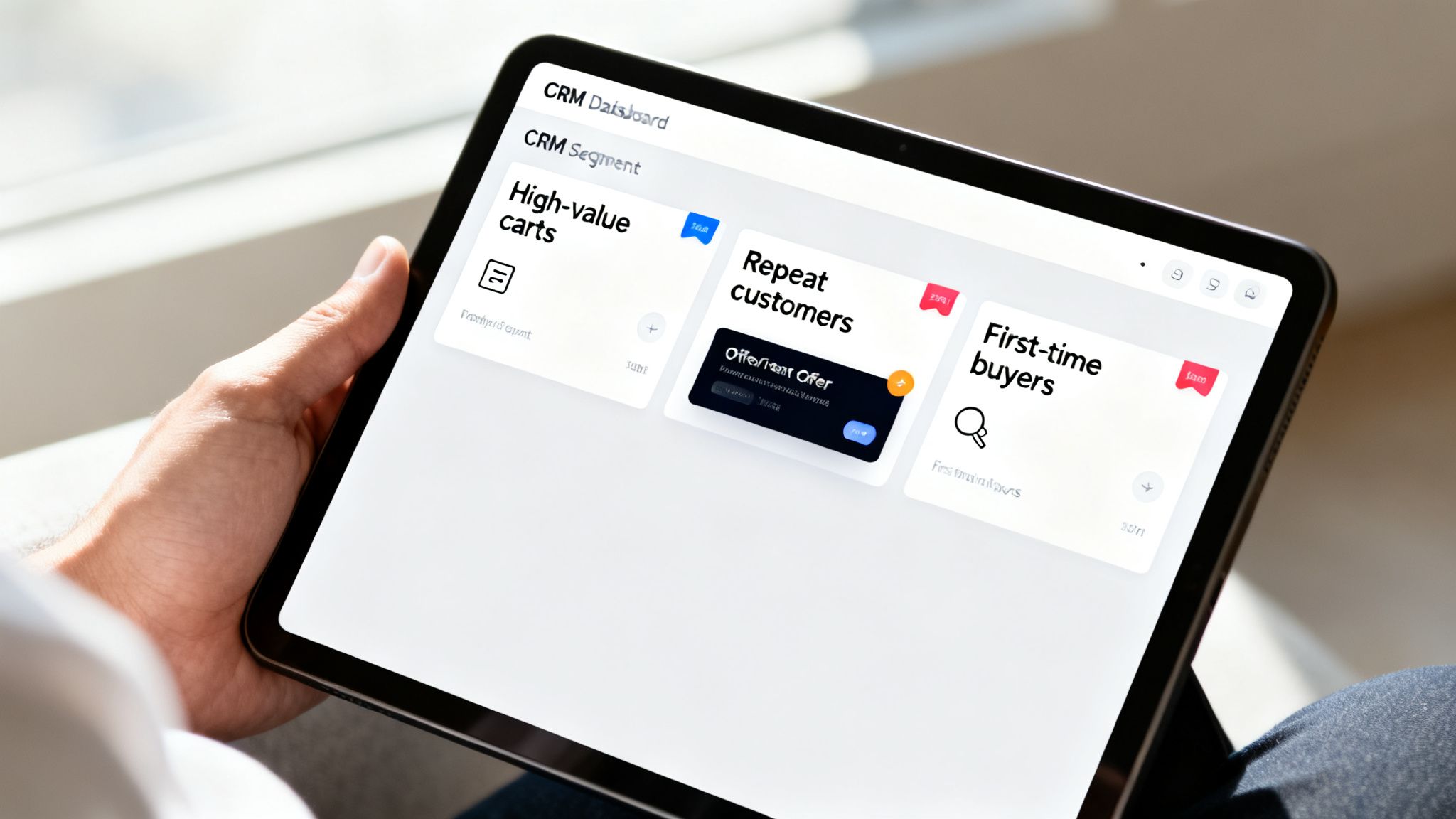
Segment by Cart Value
One of the most effective ways to segment is by the total dollar value sitting in the cart. This simple tactic is key to protecting your profit margins. You can avoid giving away the farm on small orders while still rolling out the red carpet to clinch those big-ticket sales.
- High-Value Carts (e.g., over $150): These folks are serious. They’ve shown major buying intent, and their order represents a significant chunk of revenue. Don’t be shy here. A compelling incentive like 15% off or free expedited shipping is often all it takes to close the deal. The potential return more than justifies the cost.
- **Low-Value Carts (e.g., under **50): For these smaller checkouts, a percentage-based discount can quickly eat into your profits. A better move is to offer a small, fixed-amount discount (like ****5 off) or to skip the discount entirely. Instead, focus on building trust by reminding them about your easy returns or showcasing stellar customer reviews.
Segment by Customer History
How you talk to a customer should depend on your history with them. A loyal fan who shops with you every month has different expectations than someone who just discovered your store for the first time. Segmenting by their purchase history lets you have the right conversation.
For instance, you could break your audience into groups like these:
- First-Time Shoppers: These customers are still sizing you up. An abandoned cart is your chance to make a great second impression. A small welcome offer, like 10% off their first purchase, can be the perfect nudge they need to take the plunge.
- Repeat Customers: A generic discount might feel a bit cold to a loyal customer. Instead, call out their loyalty directly. Try messaging like, “As one of our regulars, we wanted to make sure you didn’t miss out.” You could even sweeten the pot with an exclusive perk, like bonus loyalty points or early access to an upcoming sale.
- High-Lifetime-Value (LTV) Customers: These are your VIPs, plain and simple. For this group, you might even have a customer support team member send a personalized follow-up. If you do automate, offer them a significant, exclusive discount to show them how much you value their business. Getting this right means really knowing your customer base; you can dive deeper into grouping them effectively with this guide on email segmentation strategy.
Segment by Product Category
Sometimes, what they left behind is just as telling as who they are. The specific items in a cart can give you major clues about a shopper’s needs and potential hesitations. By segmenting based on product category, you can send hyper-relevant content that tackles those unspoken questions head-on.
Let’s walk through a real-world scenario. A shopper abandons a cart containing a high-end, technical skincare product.
Instead of the standard “Did you forget this?” email, you could send a category-specific follow-up that includes:
- A link to a quick “how-to” video showing the product in action.
- Rave reviews from other customers who saw amazing results.
- An offer for a free sample of a complementary product from the same skincare line. Suddenly, your email isn’t just a sales pitch. It’s a genuinely helpful resource that empowers the customer to make a confident, informed decision. That’s how you turn an abandoned cart into a completed purchase.
Your Secret Weapon: The Frictionless Checkout Link
A killer subject line and great email copy will get you the click, but that’s only half the battle. The real magic in a high-converting cart abandonment email happens after the click. Think about it: if your link just dumps a shopper back on a generic product page or, even worse, an empty cart, you’re just reintroducing the same friction that made them leave. You’re asking them to do all the work again.
The goal here is a seamless, one-click path straight to a completed purchase. This is where dynamic, personalized checkout links become your most powerful recovery tool.
Let’s paint a picture. A customer opens your second recovery email, sees that tempting 15% discount, and clicks “Complete My Order.” Instead of fumbling with a promo code, they land directly on their Shopify checkout page. Their items? Already there. Their shipping info? Pre-filled. And that 15% discount? It’s already applied to the total. All they have to do is pay.
This is what a frictionless experience looks like. It demolishes every barrier, turning a simple reminder into an effortless sale.
How to Engineer a Seamless Return
Building these powerful links is actually pretty straightforward. With a tool like Checkout Links for Shopify, you can generate unique URLs that carry specific instructions. These aren’t just dumb links back to your homepage; they are smart pathways that rebuild a customer’s cart exactly as they left it.
This process is designed to be intuitive, letting you embed a highly effective recovery machine right into your email templates.
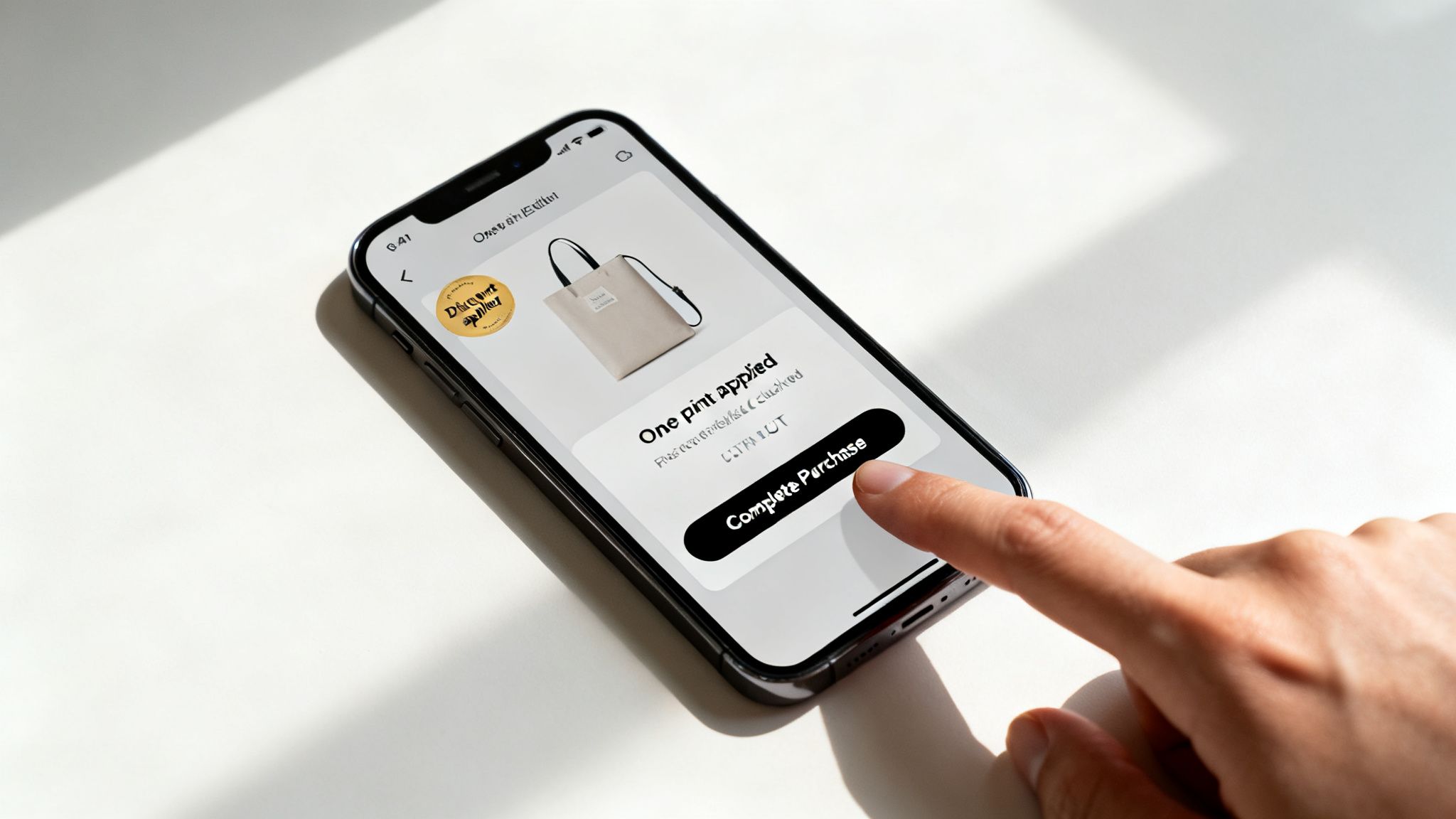
As you can see, you can easily generate links that not only pre-load a cart but also automatically apply specific discounts, making the customer’s journey back to their cart incredibly simple.
Next-Level Tactics for Creating Real Urgency
Once you’ve nailed the basic pre-filled cart link, it’s time to layer in some powerful psychological motivators.
This means getting more creative than just a static “10% off” offer. You can build time-sensitivity and exclusivity directly into the link itself. Here are a few ways I’ve seen this work wonders:
- Time-Sensitive Discounts: Generate a link with a discount that literally self-destructs after a set period, like 24 hours. This works perfectly with the “last chance” email in your sequence, making the offer feel genuinely scarce.
- Scheduled Links: Planning a flash sale to win back older abandoned carts? You can create links that only become active during a specific time window, like a weekend promotion.
- Passcode-Protected Offers: To add a real VIP feel, generate links that require a simple passcode (which you share in the email) to unlock a special deal. It’s a small step that makes the offer feel much more exclusive. When you embed these features directly into your checkout links, you’re not just sending a reminder—you’re creating a compelling, time-sensitive event. If you want to learn more about how to send links that do more than just redirect, this is the key. These advanced strategies make your recovery emails work so much harder, turning hesitation into immediate action.
How to Measure and Optimize Your Email Performance
https://www.youtube.com/embed/IhIdlcBTf5Y
Getting your cart abandonment sequence live is a major milestone, but it’s not the finish line. A truly effective campaign is never a “set it and forget it” project. Think of it as a living strategy, one that you need to constantly nurture with real-world data to turn it into a powerhouse revenue recovery tool.
First, let’s set some expectations. The global average for cart abandonment is around 70%, so don’t be discouraged. It’s a normal part of e-commerce. It’s also interesting to note how this changes by device: mobile phones hit 75.5%, while desktops are a bit lower at 69.04%. Knowing this helps you set realistic goals and understand you’re tackling a universal challenge, not a unique problem. For a deeper dive, check out the complete breakdown of cart abandonment stats.
The Metrics That Actually Matter
To get a real pulse on your performance, you need to watch a handful of key indicators. These KPIs will tell you the story of what’s resonating with your customers and what’s getting ignored, so you can make smart, data-backed adjustments.
Here are the core numbers you should have on your dashboard:
- Open Rate: This is your first impression—a direct reflection of how compelling your subject line is. If nobody’s opening the email, the rest of your work is for nothing.
- Click-Through Rate (CTR): This tells you if your email’s content—the copy, the offer, the visuals—is doing its job. A high open rate with a low CTR is a classic sign that your subject line wrote a check the email body couldn’t cash.
- Conversion Rate: The bottom line. This is the percentage of people who clicked through and actually finished their purchase. It’s the most direct measure of your sequence’s success.
- Revenue Recovered: The dollars and cents your campaign clawed back. This is the metric that proves the ROI of your efforts to everyone in the company.
A Realistic Approach to A/B Testing
Data is only as good as the action you take on it. A/B testing is how you turn those numbers into better results by testing one change at a time to see what your audience prefers. The key is to start with the changes that can make the biggest difference.
Here are a few high-impact A/B tests to get you started:
- Subject Lines: Try a direct approach (“You left something behind”) against an urgency-driven one (“Your items are selling out!”).
- Discount Offers: This is a classic for a reason. Pit Free Shipping vs. 15% Off. The winner might surprise you; sometimes the perceived value of free shipping outweighs a percentage discount, even if it costs you less.
- Email Timing: Experiment with the cadence. Does sending the first email 30 minutes after abandonment convert better than waiting a full hour? Test it and find out what the sweet spot is for your customers.
- CTA Copy: Test your button text. Is “Complete Your Purchase” more effective, or does a benefit-focused CTA like “Claim Your 15% Off” drive more clicks? By methodically testing these core components, you’ll build a clear picture of what works, allowing you to continually refine your strategy and recover more revenue.
Common Questions About Cart Abandonment Emails
Even the best-laid plans come with questions. When you’re setting up your cart abandonment flows, a few common hurdles tend to pop up. Let’s walk through some of the most frequent questions I hear from Shopify merchants so you can get ahead of them.
How Many Cart Abandonment Emails Should I Send?
I’ve found the sweet spot is a sequence of three emails. Any more, and you risk annoying people. Any less, and you’re leaving money on the table. This isn’t just a random number; it’s a proven cadence that respects the customer’s decision-making process.
- Email 1 (Within 1 Hour): Think of this as a helpful nudge. “Hey, did you forget something?” The purchase is still fresh in their mind, so a simple reminder often feels like good customer service, not a hard sell.
- Email 2 (24 Hours Later): This is where you can sweeten the deal. A little incentive—like a modest discount or a free shipping offer—is often all it takes to bring someone back.
- Email 3 (48-72 Hours Later): Time to introduce a bit of urgency. This final email is your last shot, reminding them their special offer or reserved cart is about to disappear. This timing gives you multiple chances to reconnect without flooding their inbox.
Will Offering Discounts Tank My Profit Margins?
That’s a fair question, and a real concern for many store owners. The short answer is no—if you’re smart about it.
Slapping a 20% off coupon on every single abandoned cart is a recipe for disaster. That’s not a strategy; it’s a giveaway. Instead, be selective. You don’t even need to put a discount in the first email. Give them a chance to convert on their own terms first.
What’s the Single Most Important Part of a Recovery Email?
You can have the wittiest subject line and the most beautiful email design, but none of it matters without one thing: a frictionless call-to-action (CTA).
Your entire goal is to make it absurdly simple for someone to finish what they started. When they click that link in your email, it must take them directly back to a pre-populated checkout page.
Any friction—making them re-enter their info, hunt for a promo code box, or add items back to the cart—will kill your conversions. The path back to their cart should be instant and effortless.
Ready to turn abandoned carts into effortless sales? Checkout Links helps you create powerful, pre-filled checkout links with discounts already applied, making it incredibly simple for your customers to complete their purchase. Start recovering more revenue today.