The path a person takes from first hearing about your brand to becoming a die-hard fan is broken down into five key stages. We call this the customer journey, and it typically flows from Awareness to Consideration, Decision, Retention, and finally, Advocacy. Getting a handle on this progression is a game-changer for any business that wants to grow.
Why Your Customer Journey Is a Roadmap, Not a Funnel

For a long time, everyone talked about the “sales funnel.” You’d pour leads in the top, and with any luck, a few customers would drip out the bottom. But that’s an outdated, rigid way to look at things, especially for a Shopify merchant in 2026. Today’s customers are all over the place—they don’t just move in a straight line. They bounce between social media, blogs, and your store, comparing and researching as they go.
Instead of a funnel, picture the customer journey as a winding road trip. Each stage is a different stop along the way, and at every stop, your customer has a new set of needs. Your job isn’t to force them down a single path but to be a great guide, meeting them right where they are with exactly what they need at that moment.
Understanding the Five Core Stages
To get inside your customer’s head, you need to get familiar with customer journey mapping. This process is all about visualizing every single touchpoint from their perspective. It reveals a path that usually unfolds across five distinct phases:
- Awareness: The “aha!” moment when someone first realizes your brand exists.
- Consideration: They’re weighing their options, checking out your products, and seeing how you stack up against the competition.
- Decision: This is it—the moment they pull out their credit card and make a purchase.
- Retention: What happens after the sale? This is where you work to turn a one-time buyer into a repeat customer.
- Advocacy: The ultimate goal. Your happy customers start telling their friends about you, becoming your most authentic marketing team.
Moving from a funnel mindset to a journey-first approach is more than just a change in vocabulary. A funnel is obsessed with the transaction, often overlooking the actual person. A journey map, on the other hand, is all about building a relationship, seeing the sale as just one milestone in a much longer, more valuable connection. For Shopify merchants, this perspective is everything—it unlocks smarter ways to create a seamless and profitable experience, from that very first impression to lifelong loyalty.
The Awareness Stage: Making a Killer First Impression
Think of the Awareness stage as your brand’s big debut. It’s that first “hello” when a potential customer stumbles across your name while scrolling Instagram, searching Google, or watching an influencer unbox one of your products.
This moment is your one shot to cut through the noise and make them pause. You’re not trying to shout at everyone; you’re trying to catch the eye of the right people and spark a little curiosity that makes them think, “Huh, what’s this all about?”
Capturing Attention in a Crowded Market
In a world saturated with ads and content, just showing up isn’t enough. To make a real impact, your strategy needs to be smart, targeted, and focused on creating an instant connection.
Here are the most effective ways to build that initial spark:
- Paid Social Ads: Platforms like Instagram and TikTok are goldmines for showcasing your products to hyper-specific audiences based on their interests and behaviors.
- Search Engine Optimization (SEO): When people have a problem, they Google it. By creating blog posts and product pages that answer their questions, you meet them exactly when they need you.
- Influencer Marketing: Partnering with creators who genuinely love what you do puts your brand in front of an audience that already trusts their recommendations.
- Content Marketing: Think shareable videos, genuinely helpful guides, or even a meme that hits just right. This is how your brand gets passed around organically. Remember, this first touchpoint is where 100% of your potential customers start. And with 70-80% of consumers researching online before they even think about buying, you have to get it right. To make that first impression stick, you need to build brand awareness that lasts.
From Passive Glance to Active Click
Traditionally, this stage was all about passive discovery. A customer saw a billboard or a magazine ad and maybe remembered the brand later. Today, we can do so much better. Smart Shopify merchants are turning that fleeting glance into an immediate action using tools like Checkout Links.
Imagine an influencer drops a limited-edition sneaker in their Instagram Story. Instead of just tagging your profile, they can include a direct checkout link. One tap, and their followers are instantly transported to a pre-filled cart, ready to buy. This simple link completely reshapes the old rules of awareness.
Here’s a quick breakdown of what you need to focus on during this crucial first stage.
Awareness Stage At a Glance
This table gives you a clear snapshot of the goals, touchpoints, and metrics that matter most when you’re introducing your brand to the world.
| Key Goal | Common Touchpoints | Primary KPIs |
|---|---|---|
| Grab attention and create brand recognition. | Social media ads, blog posts, influencer content, digital PR. | Impressions, Reach, Website Traffic, Social Engagement. |
By using direct checkout links, you close the gap between that first “ooh, I want that” moment and the final sale. Shopify reports have shown this tactic can boost conversions from awareness to the next stage by 35%, especially for things like flash sales or exclusive drops. You’re not just making people aware—you’re making it incredibly easy for them to act on that newfound interest.
The Consideration Stage: Becoming the Obvious Choice
Alright, so a potential customer knows you exist. They’ve moved from “Who are you?” to “What’s this all about?” Welcome to the Consideration Stage—one of the most critical moments in their entire journey with you.
Think of it like this: they’re in the digital fitting room. They’re holding your product up, checking the stitching, comparing the price tag, and mentally stacking it up against a few other options. Their browser tabs are probably a chaotic mix of your product page, a competitor’s, and maybe a few review sites. They’re no longer just browsing; they’re actively investigating.
At this point, they’re asking one simple question: “Is this the best choice for me?” Your job is to make the answer a resounding “yes.” You need to go from being just an option to being the only option that makes sense.
Building Trust When Scrutiny Is High
During the consideration phase, trust is everything. A slick product photo and a punchy description aren’t enough anymore. Shoppers are looking for proof—real, hard evidence that your product is as good as you say it is and that your brand will have their back if something goes wrong.
Here’s how you build that confidence and stand out from the noise:
- Show, Don’t Just Tell: Let your existing customers do the talking. Plaster your product pages with glowing reviews, user-generated photos, and video testimonials. Nothing sells a product better than seeing someone else love it.
- Answer Questions Before They’re Asked: Create detailed buying guides, side-by-side comparison charts, or video demos. If a customer has a question, you should have already answered it.
- No Surprises: Be painfully transparent about shipping costs, delivery estimates, and your return policy. A surprise “handling fee” at checkout is the fastest way to lose a sale.
- Be There to Help: Use a live chat or a well-programmed chatbot to answer questions instantly. Removing that tiny bit of friction can be the difference between a sale and an abandoned cart. Make no mistake, this stage is a major drop-off point. It’s where price sensitivity and a lack of clear information can really hurt your bottom line. Nailing this experience is non-negotiable. Find out more about how customer journey mapping enhances engagement and retention.
Playbook: Using Checkout Links for Smart Retargeting
One of the most powerful moves you can make during this stage is a smart retargeting campaign. When someone views a product but doesn’t buy, they’ve raised their hand and said, “I’m interested!” Now it’s your turn to reel them back in with an offer they can’t refuse.
Checkout Links makes this almost too easy. Instead of just sending them back to the same old product page, you can generate a dynamic checkout link with a discount already built-in. Then, you can pop that link right into your retargeting ads on Facebook or Instagram.
See what happened there? You just vaporized three or four steps in the buying process. They don’t have to find the product again, add it to their cart, or fumble with a promo code. You made buying from you the path of least resistance.
Using A/B Testing to Find Your Winning Offer
So, what’s the magic offer? Is it 10% off? Free shipping? A free gift? Guessing is a great way to waste money. This is where A/B testing comes into play.
With Checkout Links, you can create a couple of different offers and test them against each other to see what truly motivates your customers. It’s a data-driven way to stop guessing and start knowing. You can get a much better feel for what your audience wants by learning what is segmentation and how to apply it.
Quick A/B Test Example:
- Offer A: Create a dynamic checkout link for a product with a 15% discount automatically applied.
- Offer B: Create another link for the same product, but this one offers free shipping. Now, run retargeting ads to two similar audience groups, with each group seeing one of the offers. After a few days, the analytics will tell you the real story. You might be surprised to find that your customers would rather have free shipping than a 15% discount. That’s a powerful insight that can sharpen your entire marketing strategy and help you turn hesitant lookers into happy buyers.
The Decision Stage: Engineering a Frictionless Purchase
This is the moment of truth. After all the browsing and comparing, your customer has finally gone from “should I?” to “I will.” The Decision stage is where intent turns into action, and for any Shopify merchant, it’s the most critical conversion point in the entire journey.
But this is also where the real danger lurks. The slightest bit of friction—a confusing form, a surprise shipping cost, one too many clicks—can send a committed buyer running for the digital hills. Building a smooth, almost invisible path to purchase isn’t just a nice-to-have; it’s absolutely essential.
Pinpointing and Eliminating Purchase Barriers
At this stage, your customer’s intent is high, but their patience is razor-thin. They are ready to give you their money, but they won’t work hard to do it. The most common roadblocks that kill a sale are often surprisingly simple, yet they contribute to a massive loss in revenue every single day.
Keep an eye out for these key friction points:
- Complex Checkout Forms: Asking for a bunch of unnecessary information or dragging people through a multi-page checkout process just creates fatigue.
- Surprise Costs: Nothing kills the mood faster than an unexpected shipping fee or tax calculation popping up at the last second.
- Forcing Account Creation: Demanding that a new customer create a full account before they can buy is a major roadblock and feels like a chore.
- Limited Payment Options: If you don’t offer a customer’s go-to payment method, like Apple Pay or PayPal, it can be an instant deal-breaker. The goal here is to make the final step feel completely effortless. Every field they have to fill out and every click they have to make is a potential exit point.
Playbook: Creating an Instant Purchase Path
Let’s say you’re running a flash sale for your email subscribers. Normally, you’d send them to a product page where they have to add the item to their cart, then navigate to the checkout. We can do better. We can remove all those steps.
This is where a tool like Checkout Links fundamentally changes the game.
You can generate a direct link to checkout with the flash sale discount already applied. Want to make it feel even more exclusive? Add passcode protection. Now, when a subscriber clicks the link in your email, they completely bypass the product page and the cart.
Example Playbook: Flash Sale for VIPs
- Generate the Link: Create a checkout link for the sale item and automatically apply a 25% discount.
- Add Exclusivity: Protect the link with a simple passcode, like “VIP25,” which you’ll share only with your email list.
- Schedule the Campaign: Set the checkout link to activate and deactivate at specific times, perfectly aligning with your flash sale window.
- Launch: Send an email to your subscribers with the direct link and the passcode. They click, enter the code, and land directly on a pre-filled, discounted checkout page, ready to pay. This strategy transforms a clunky, multi-step process into a single, decisive action. You’ve eliminated the friction and made buying from you the easiest and most obvious choice. For time-sensitive offers, that kind of speed can dramatically boost your conversion rate.
Optimizing Offers with A/B Testing
So, how do you know if your offer is actually any good? A/B testing your checkout links is the key to making data-driven decisions instead of just guessing. Before a huge sales event like Black Friday, you can test different offers on smaller segments of your audience to see what really gets them to convert.
Simple A/B Test Scenario:
- Link A: A checkout link offering Free Shipping on a specific product.
- Link B: A checkout link for the same product offering 20% Off. Run a small campaign targeting two similar audience segments, one for each link. The analytics will quickly tell you which offer drives a higher conversion rate. These insights are pure gold, helping you craft more effective promotions and maximize revenue when it matters most. By perfecting this final step, you turn hesitant interest into confirmed cash flow.
Building Lifelong Fans in the Retention and Advocacy Stages
So, you’ve made the sale. Congratulations! But don’t pop the champagne just yet. The first purchase isn’t the finish line; it’s the starting gun for the most profitable part of the customer journey. You’ve earned their trust and their money, and now the real work begins: turning that one-time transaction into a genuine, long-term relationship.
This is where the final two stages, Retention and Advocacy, come into play. Think of it this way: Retention is earning a second date after a great first one. Advocacy is when they start telling all their friends how amazing you are. Skipping these stages is a massive missed opportunity, plain and simple.
Retention: Giving Them a Reason to Come Back for More
The Retention stage is all about creating an experience so good that customers want to come back. It’s no secret that it costs a whole lot more to find a new customer than to keep an existing one. In fact, a small 5% bump in customer retention can increase your profits by a staggering 25% to 95%.
But a solid retention strategy isn’t about blasting your customer list with generic “we miss you” emails. It’s about showing them you’re paying attention and that you value their business.
Here’s what truly effective retention looks like:
- Thoughtful Follow-Ups: Go beyond the standard order confirmation. Send an email with tips on how to get the most out of their new product. Check in a few weeks later to see how they’re loving it.
- VIP Treatment: Make your existing customers feel special. Give them early access to new collections, offer exclusive discounts only they can get, or create members-only content.
- Smart Loyalty Programs: Reward repeat business with points they can actually use, discounts that feel substantial, or surprise gifts. It gamifies the experience and makes them feel appreciated for sticking with you.
Playbook: The Exclusive “Thank You” Offer
One of the easiest yet most powerful retention tactics is a simple “thank you” offer sent shortly after their first purchase. With Checkout Links, you can create an offer that feels exclusive and is incredibly easy to redeem.
Example Playbook: The VIP Welcome-Back Offer
- Craft the Perfect Link: Start by creating a checkout link for a popular product that complements their first purchase. Apply a special discount that feels generous, like “20% Off Your Next Order.”
- Add an Exclusive Touch: Lock the link with a simple passcode, something memorable like “WELCOMEBACK.” This small step makes the offer feel like a private invitation.
- Automate the Delivery: Set up an automated email to land in their inbox one week after their first purchase. The message should be simple: thank them for their order and share the exclusive link and passcode for their next one. This isn’t just another discount. It’s a gesture that creates a sense of belonging and appreciation. By removing all the friction—no codes to copy, no hoops to jump through—you’ve made it completely effortless for them to become a repeat customer.
Advocacy: Turning Happy Customers into Your Best Marketers
Advocacy is the holy grail of the customer journey. This is the moment your satisfied customers become a volunteer marketing army, spreading the word about your brand through genuine, trusted recommendations.
When a customer advocates for you, they’re doing more than just leaving a five-star review. They are putting their own reputation on the line to vouch for your brand. That kind of social proof is priceless because we all trust recommendations from friends and family far more than any slick ad campaign.
Your job is to make it incredibly simple—and rewarding—for your biggest fans to share the love.
Playbook: The Simple “Share and Earn” Referral Program
You don’t need a complicated, expensive system to spark advocacy. A straightforward referral program can be up and running in minutes using Checkout Links.
Example Playbook: Share and Earn
- Create a Shareable Offer: Generate a checkout link for one of your flagship products. Add a special discount just for their friends, like “15% off their first order.”
- Reach Out to Your VIPs: Send a personal email to your most loyal customers. Let them know you appreciate them and invite them to share the special link with friends they think would love your products.
- Reward Your Advocate: When a new customer makes a purchase through their link, send the original advocate a thank-you gift, like a personal discount code or store credit for their next purchase. This creates a win-win-win. The new customer gets a great deal, your loyal fan gets rewarded for their support, and you acquire a new customer through a trusted, low-cost channel. You’ve officially closed the loop, turning a one-time buyer into a powerful engine for new growth.
4. Your Playbook for Every Customer Journey Stage
https://www.youtube.com/embed/fYgls0f9Ilc
Knowing the theory behind the customer journey is great, but the real magic happens when you put that knowledge into practice. This section is all about action. Think of it as your tactical guide for using Checkout Links to solve real-world problems at every stage of the journey.
The goal is to move customers seamlessly from one stage to the next, especially from Retention to Advocacy. When you nail the post-purchase experience, you don’t just get another sale—you create a fan who’s ready to shout about your brand.
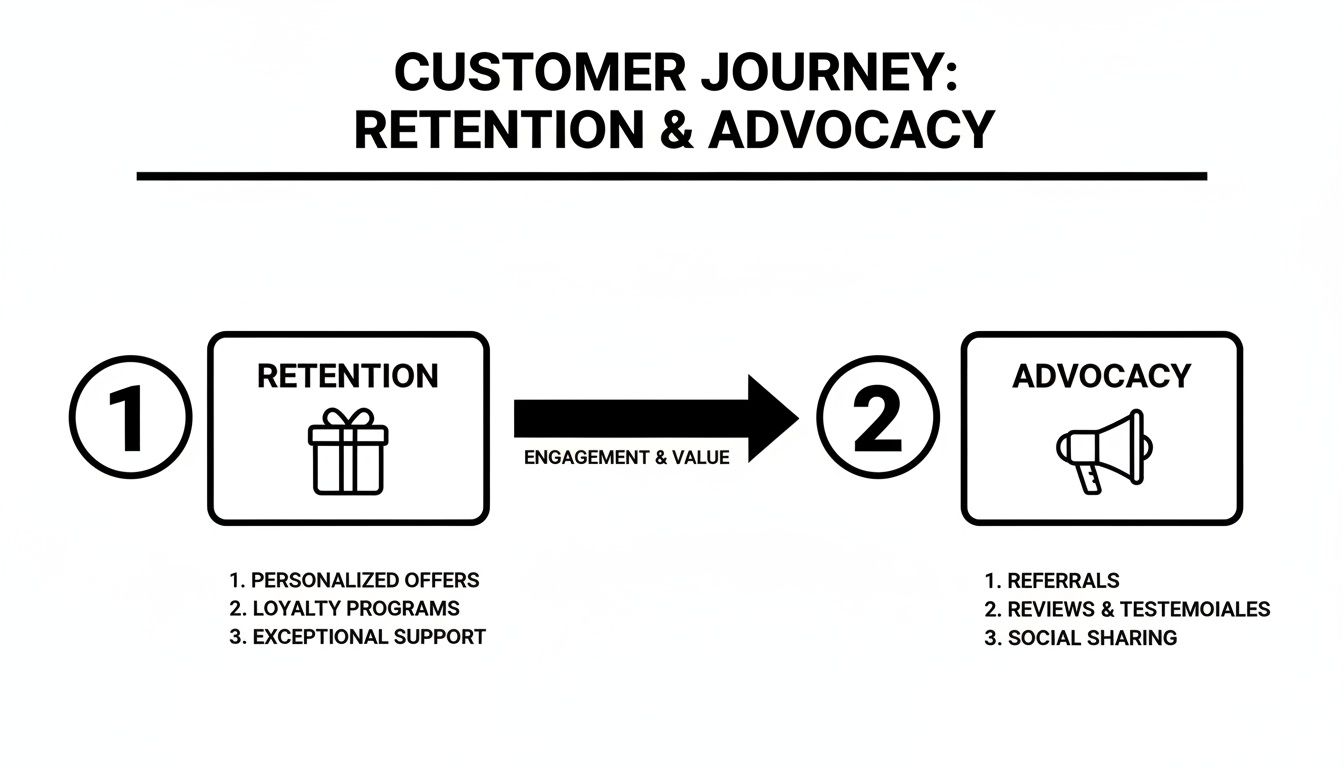
This simple visual shows it perfectly: a great retention strategy (the gift) naturally turns happy customers into brand champions (the megaphone). It’s a powerful growth loop that fuels itself.
Your Checkout Links Playbook for Every Customer Journey Stage
Here’s where we get specific. The table below breaks down the common hurdles Shopify merchants face at each stage and gives you a concrete Checkout Links feature to solve it, complete with a real-world playbook you can use today.
This isn’t just theory; these are ready-to-go tactics designed to smooth out friction and guide your customers forward. For an even more detailed breakdown, be sure to read our complete guide on the ecommerce customer journey.
| Journey Stage | Common Merchant Challenge | Checkout Links Solution | Example Playbook |
|---|---|---|---|
| Awareness | Converting passive social media viewers into active buyers. | Dynamic Links | Launch a new product by adding a direct checkout link to an influencer’s Instagram Story. Viewers can buy instantly, no website navigation needed. |
| Consideration | Recovering abandoned carts from shoppers who are on the fence. | A/B Test Discounts | Run retargeting ads targeting cart abandoners. Test two links: one offering 10% off, the other offering free shipping, to see which one converts better. |
| Decision | Closing sales quickly during a high-urgency event like a flash sale. | Passcode-Protected Links | Build hype by sending your email list an exclusive link for a flash sale. The passcode creates a feeling of VIP access and drives immediate action. |
| Retention | Encouraging that crucial second purchase from a first-time buyer. | Scheduled Discount Links | Set up an automated “Thank You” email that goes out one week after the first purchase. Include a unique discount link that activates on a schedule to bring them back. |
| Advocacy | Turning your loyal customers into your best marketers. | Shareable Links | Create a “Refer-a-Friend” link. The new customer gets a discount, and the original advocate gets store credit after their friend makes a purchase. |
By mastering the tactics for each phase, you’re not just making individual sales—you’re building a stronger, more predictable business that grows with every happy customer.
Frequently Asked Questions
As you start mapping out your customer’s path from discovery to purchase, you’re bound to have some questions. Let’s walk through a few of the most common ones that come up for Shopify merchants.
Which Customer Journey Stage Is Most Critical?
Every stage is important, but if you have to focus your attention somewhere, make it the Decision stage. This is where the magic happens—or doesn’t. It’s the final step where a browser becomes a buyer, and a staggering 70% of shoppers drop off right here.
Think about it: all the time, money, and creativity you pour into ads and content all lead to this one moment. A clunky checkout process or a surprise shipping cost can undo all that hard work in an instant. Nailing this stage by making the purchase effortless directly boosts your revenue and proves your marketing efforts are paying off.
How Can I Measure Success Across the Journey?
You can’t just look at sales and call it a day. To really understand what’s working, you need to use the right metrics for each specific stage of the journey. This gives you a complete dashboard view of your business, not just a single gauge.
Here’s a practical way to break it down:
- Awareness: Are people finding you? Look at your Reach, Impressions, and overall Website Traffic.
- Consideration: Are they interested? Check Click-Through Rates (CTRs) on your ads, Time on Page, and how many people sign up for your newsletter.
- Decision: Are they buying? This is where you obsess over your Conversion Rate, Average Order Value (AOV), and Cart Abandonment Rate.
- Retention: Are they coming back? Track your Repeat Purchase Rate and Customer Lifetime Value (CLV).
- Advocacy: Are they telling their friends? Monitor Referral Rates and positive Social Media Mentions.
Can Small Businesses Really Use Journey Mapping?
Yes, 100%. Customer journey mapping isn’t just for mega-brands with huge marketing teams. The core idea is simply to understand your customer’s experience, and that’s crucial for any size business.
The secret is to keep it simple. Don’t try to optimize every single touchpoint at once. Find your biggest bottleneck and start there. For example, if your cart abandonment rate is through the roof, put all your energy into fixing the Decision stage. You don’t need a massive, complicated campaign; sometimes, a simple tool like a direct checkout link in an abandoned cart email can have a much bigger impact. The principles scale, whether you’re making 10 sales a day or 10,000.
Ready to eliminate friction at every stage of your customer journey? Checkout Links empowers Shopify merchants to create seamless purchase paths with dynamic links, automated discounts, and powerful analytics—no coding required.
Start building smoother customer journeys today with Checkout Links