Forget what you see trending on TikTok or Instagram for a minute. When it comes to reliable, profitable growth for your Shopify store, your email list is the single most powerful asset you have. This playbook is all about using email marketing to generate leads that actually turn into repeat buyers and drive serious revenue.
Why Email Is Your Strongest Shopify Growth Tool
In a world of constantly shifting social media algorithms, your email list is one of the few channels you truly own. It’s a direct, unfiltered line to your most interested prospects and your most loyal customers. Think about it—no gatekeepers, no paying to reach the audience you already built. This gives you a stable, predictable foundation for communication and sales.
On top of that, email allows for a level of personalization that other platforms just can’t touch. You can segment subscribers based on what they’ve bought, what they’ve browsed, or what they’ve told you they’re interested in. This lets you send offers and content that feel like they were made just for them, which is exactly how you build trust and get people to act.
The Unmatched Power of Email for Lead Generation
While a multi-channel approach is smart, the data consistently shows email is in a league of its own for generating new business. It’s not just a hunch; marketers live and breathe this stuff.
When asked about their most effective channels, marketing professionals consistently place email at the top of the list. Here’s a quick look at how it stacks up against other popular tactics.
Top Lead Generation Channels for Marketers
| Channel | Effectiveness Rating (% of Marketers) | Best Use Case for Shopify Stores |
|---|---|---|
| Email Marketing | 48% | Nurturing new subscribers with welcome offers, re-engaging past customers, and driving flash sales. |
| Website / Landing Pages | 44% | Capturing email signups through targeted pop-ups and dedicated offer pages. |
| Content Marketing | 43% | Attracting top-of-funnel traffic with blog posts or guides that solve a customer’s problem. |
The numbers are clear. A staggering 48% of marketers rate email as their most effective lead generation tactic, beating out even dedicated website landing pages (44%) and content marketing (43%). You can dive deeper into these lead generation statistics to see the full picture, but the takeaway is simple: direct, personal outreach gets results.
This guide is designed to get you past the generic advice and into a concrete, actionable plan. We’re going to zero in on:
- Creating irresistible lead magnets that make visitors want to subscribe.
- Building automated email sequences that warm up new leads and guide them to their first purchase.
- Using conversion-focused tools to create one-click buying opportunities right inside your emails.
Ultimately, mastering email marketing to generate leads is about building a sustainable growth engine for your Shopify store. It’s how you maximize customer lifetime value and create a genuine community around your brand. Let’s get into how you can build that engine, starting with your lead capture system.
Building Your Shopify Lead Capture System
Before you can even think about sending your first marketing email, you have to nail the system that turns casual site visitors into engaged subscribers. This is way more than just slapping a “subscribe” button on your homepage and hoping for the best. It’s about creating a genuinely compelling reason for someone to hand over their email address. The whole foundation of this process is understanding how to build an email list that actually grows your business, not just a list of names.
Your most powerful tool here is the lead magnet—that irresistible freebie you offer in exchange for an email. It’s a simple trade that, when you get it right, feels like a massive win for the customer. The trick is to offer something that delivers immediate value and is a natural extension of the products you sell.
Designing a Lead Magnet That Actually Converts
The best lead magnets solve a very specific problem or satisfy an immediate desire for your ideal customer. Let’s be honest, a generic “subscribe to our newsletter” CTA just doesn’t cut it anymore. Your offer needs to have a tangible benefit that makes signing up a no-brainer.
For a Shopify store, these offers usually fall into a few tried-and-true categories:
- Discounts and Special Offers: This is the most direct route. A 15% discount on a first purchase is a classic for a reason—it’s a powerful motivator that directly ties subscribing to saving money.
- Exclusive Access: Offering early-bird access to a new product drop or a secret members-only sale creates a real sense of FOMO. This works wonders for brands that have already built a loyal, enthusiastic community.
- Valuable Content: Think like a publisher. For a beauty brand, this could be a “Beginner’s Guide to Building a Skincare Routine.” For a coffee gear shop, maybe a “5-Minute Home Barista” video course. This approach positions you as a trusted expert, not just a seller.
Put yourself in your customer’s shoes. What do they struggle with? What do they want to achieve? If you sell high-end kitchen gadgets, a beautifully designed recipe e-book is a perfect match. Fitness apparel? A free 7-day workout plan is an obvious win. The goal is to make the offer so relevant they’d feel silly saying no. If you’re looking for more inspiration, you can find a ton of great ideas in email opt-in marketing.
A great way to brainstorm is to consider what makes sense for your specific niche.
Lead Magnet Ideas for Different Shopify Niches
Here’s a quick comparison to get your ideas flowing, breaking down what works for different types of stores.
| Lead Magnet Type | Best For (Niche) | Pros | Cons |
|---|---|---|---|
| Percentage Discount | Fashion, General Retail | High conversion rate, easy to implement | Can attract one-time bargain hunters |
| Free Shipping Code | Home Goods, Bulk Items | Reduces a major purchase barrier | Lower perceived value than a discount |
| Exclusive Content (Guide/Ebook) | Electronics, Wellness, Hobbies | Builds authority, attracts high-intent leads | Requires more effort to create |
| Quiz or Product Finder | Beauty, Supplements, Apparel | Highly engaging, provides personalized data | Technically more complex to set up |
| Giveaway or Contest Entry | Any Niche (especially with high-priced items) | Can generate a high volume of leads quickly | May attract lower-quality leads not interested in purchasing |
Ultimately, the best lead magnet is one that not only captures an email but also gives you a new subscriber who is genuinely interested in what you have to offer.
Where and How to Place Your Signup Forms
Once your lead magnet is ready, you need to put your signup forms where people will actually see and use them. Bombarding users with pop-ups the second they land on your site is a common—and annoying—mistake. The key is to integrate your forms naturally into the browsing experience.
This pop-up, for example, is a great model. It appears after a user has had a chance to look around, showing they have some level of interest.
What makes this work? It’s timely, the value prop (Get 15% Off) is crystal clear, and it only asks for the bare minimum, which lowers the barrier to entry.
Here are the most effective spots to place your forms:
- Exit-Intent Pop-Up: This is your last-ditch effort. When a user’s cursor moves toward the back or close button, a pop-up appears with an offer to convince them to stick around or come back later.
- Embedded on the Homepage: A clean, visually appealing signup section on your homepage (often right above the footer) is perfect for catching visitors who have scrolled down to learn more about you.
- Within Blog Posts: If you run a blog, this is gold. A post on “10 Ways to Style a Scarf” should have a signup form embedded right in the middle, offering a downloadable style guide or a special discount on your scarves.
- Header or Footer Bars: A subtle “sticky” bar at the top or bottom of the screen keeps your offer visible as users navigate your site, but it does so without being intrusive. And please, make sure your forms are mobile-friendly. With more than half of all web traffic coming from phones, a clunky form that’s hard to fill out on a small screen will absolutely tank your conversion rates. Keep it dead simple: one field for the email address is usually all you need. Every extra field is just one more reason for someone to bail.
Crafting Your Welcome and Nurture Sequence
When someone subscribes to your email list, you have their full attention. That moment they hit “subscribe” is the peak of their interest in your brand, and your first few emails are your absolute best shot at turning that curiosity into a sale.
If you don’t engage them right away, you’re letting your warmest leads go cold. This is where a smart, automated welcome sequence becomes your most powerful tool. It’s not just a “thanks for signing up” email—it’s a carefully planned series of messages designed to build a real connection, show off what makes your brand special, and guide new subscribers toward their first purchase.
Think of it as the digital version of a great retail experience. You’re the friendly, knowledgeable store associate who greets a new customer, makes them feel welcome, and gets them excited about what’s on the shelves.
This simple flow shows how you turn a casual browser into an engaged subscriber, starting from the initial offer and ending with that crucial first email.
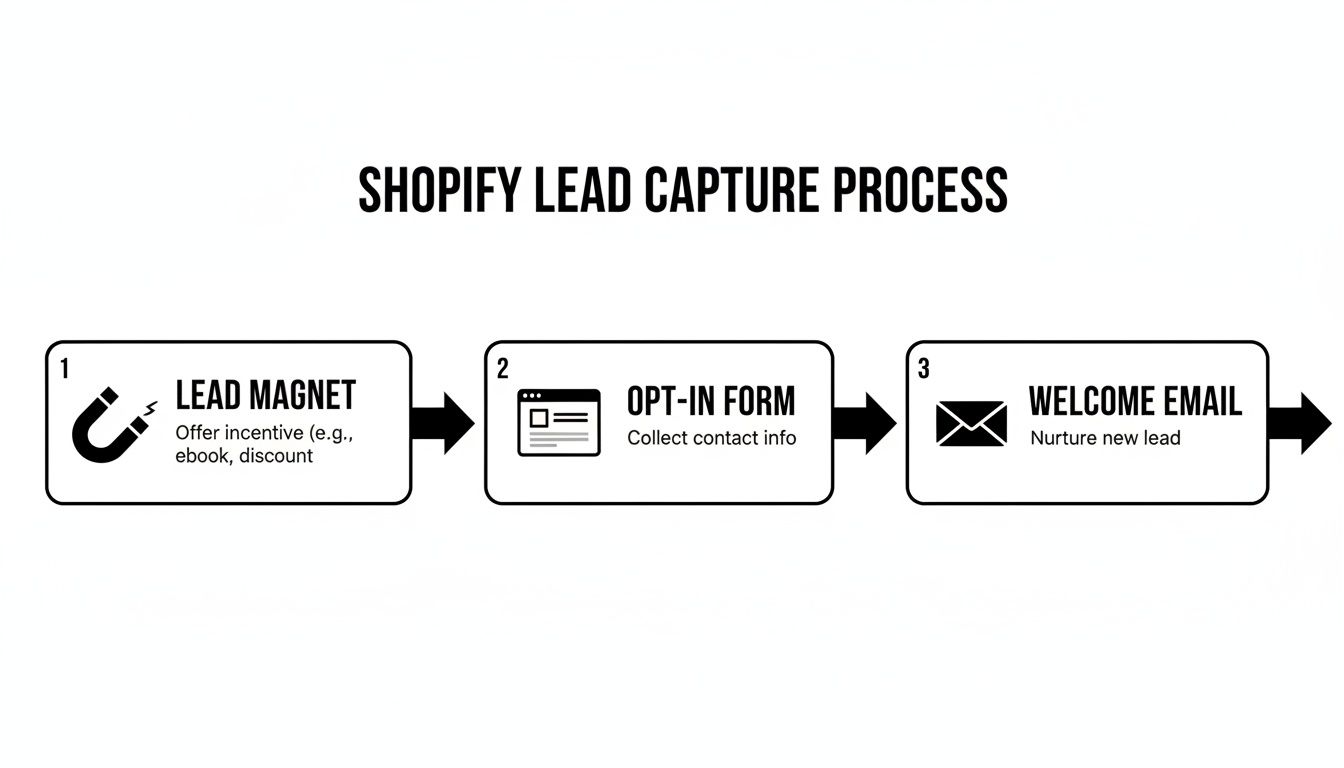
Each step flows logically into the next, making sure every new subscriber has a smooth and positive first impression of your brand.
Mapping Out Your Automated Welcome Series
A solid welcome sequence is usually three to five emails sent over about a week. This timing keeps you top-of-mind without flooding their inbox. Each email has a specific job to do, moving the person from “just looking” to “ready to buy.”
Here’s a proven framework I’ve seen work wonders for Shopify stores:
Email 1: The Instant Payout (Sent Immediately)
-
Purpose: Make good on your promise, fast. This email has one primary job: deliver the discount code, e-book link, or whatever lead magnet you offered.
-
My Advice: Don’t overcomplicate it. The main goal is to deliver the goods. A simple, warm welcome and a quick note about what they can expect from you next is all you need. Email 2: The Origin Story (Sent 1 Day Later)
-
Purpose: Build a human connection. Why did you start this brand? Were you trying to solve a personal problem? Are you passionate about ethical sourcing? This is your chance to be more than just a logo.
-
My Advice: Get personal. People buy from people, not faceless corporations. A genuine story about your mission can create a surprisingly strong bond. Email 3: The Proof is in the Pudding (Sent 3 Days Later)
-
Purpose: Build trust and slash skepticism. Show off your best-sellers alongside glowing customer reviews or user-generated content (UGC).
-
My Advice: Let your happy customers sell for you. Seeing a quote like, “This is hands-down the best moisturizer I’ve ever used!” next to a product shot is infinitely more powerful than anything you could write yourself.
By following this sequence, you’re systematically building trust, answering unspoken questions, and proving your value before you ever ask for a sale.
From Nurturing to a Sale with Checkout Links
By the time you get to the fourth or fifth email, you’ve earned the right to make an offer. You’ve delivered value, told your story, and built credibility. Now, it’s time to make buying as easy as humanly possible.
This is where you can get really smart. Instead of just linking to a product page and hoping for the best, you can send them directly to a pre-loaded cart using a dynamic checkout link.
Picture this for the final email in your sequence:
- Subject: A Welcome Offer, Just for You
- Body: You highlight a special bundle of your top products, recap the benefits, and drop in a great testimonial.
- The Call-to-Action: The button doesn’t say “Shop Now.” It says, “Claim My 15% Off Bundle.” When they click that link, they skip the product page and the cart page entirely. They land directly on a pre-filled Shopify checkout page. The product bundle is already in their cart, and their 15% welcome discount is automatically applied.
You’ve just eliminated several steps—and several chances for them to get distracted or abandon their cart. You’re taking them from a moment of high interest straight to the finish line. This one tactic can dramatically boost the conversion rate of your welcome series, turning brand new leads into paying customers in record time.
Advanced Tactics for Higher Email Conversions
So, you’ve got a solid welcome sequence in place, and new subscribers are getting a warm introduction to your brand. That’s the foundation. Now, it’s time to go beyond the basics and start implementing strategies that turn those subscribers into loyal, repeat customers.
This is where you really start to see the ROI from your email list, converting those hard-won leads with precision.
The secret sauce here is personalization at scale. It’s about making every single person on your list feel like you crafted that email just for them. This isn’t just about feeling good; it’s about getting results. When you nail this, engagement skyrockets, and you start building the kind of long-term loyalty that separates the good stores from the great ones.
Put Your Data to Work with Behavioral Segmentation
Sending the same email to your entire list is a missed opportunity. The real magic happens with behavioral segmentation—grouping subscribers based on what they actually do (or don’t do) on your Shopify store. This lets you send hyper-relevant messages that land perfectly because they reflect a subscriber’s genuine interests.
Instead of guessing what people want, you use their actions to tell you. Start thinking about segments based on these common Shopify interactions:
- Browsing History: People who viewed a specific product or category multiple times but never bought.
- Past Purchases: Customers who bought a particular item are prime candidates for cross-sells or replenishment reminders.
- Cart Abandonment: A classic for a reason. This is low-hanging fruit for recovering lost sales.
- High-Value Customers: Your VIPs. Segment them out to reward them with exclusive perks and early access. Setting up just a few of these segments can completely change your results, moving you from generic blasts to targeted, effective campaigns. For those looking to get even smarter with their targeting, exploring AI email marketing can unlock some powerful new efficiencies.
Create a Frictionless Path to Purchase
Once you know who you’re talking to, the next step is to make it incredibly easy for them to buy. The goal is to remove every possible point of friction between your email and a completed purchase. This is where direct-to-checkout links become a total game-changer.
Imagine sending an email to your “viewed product X” segment. The email shows them that exact product, maybe with a customer review, and has a strong call-to-action.
This is what it looks like behind the scenes—creating a link for a specific product with a discount already baked in. When a customer clicks this, they don’t go to the product page or the cart. They land directly at checkout with their info and discount ready to go.
This tactic is especially potent for abandoned cart emails. Don’t just remind them; give them a one-click path to finish what they started.
Drive Action with Urgency and Exclusivity
Another powerful tool in your arsenal is making your subscribers feel special while creating a sense of urgency. People are simply more likely to act when they feel like they might miss out.
Here are a few high-impact ideas to try:
- Flash Sales: Announce a surprise 24-hour sale just for your email list. It’s a great way to reward subscribers and drive a quick burst of revenue.
- Early Access: Let your subscribers be the first to shop new product launches or seasonal collections. It makes them feel like insiders.
- Limited-Time Bundles: Create unique product bundles that are only available through a link in your email for a short period. The psychology is straightforward. These offers make your subscribers feel valued and part of an exclusive club. This doesn’t just drive immediate sales; it strengthens their connection to your brand, making them far less likely to unsubscribe.
By combining smart segmentation with frictionless checkout links and urgency-driven offers, you create a powerful system that consistently turns leads into profitable, long-term customers.
Measuring Performance and Optimizing Your Funnel
So, you’ve launched your email sequences. That’s a massive step, but the real work starts now. To genuinely master email marketing to generate leads, you have to approach it like a science. The old saying holds true: you can’t improve what you don’t measure. It’s time to look past vanity metrics and zero in on the numbers that actually grow your Shopify store’s revenue.
https://www.youtube.com/embed/AJGtpQ6h9FA
Sure, it feels good to see high open rates, but those numbers don’t pay the bills. The goal isn’t just to get opens; it’s to build a predictable, profitable funnel. This means taking a serious look at the key performance indicators (KPIs) that tell you what’s working and, just as importantly, what isn’t.
KPIs That Actually Drive Your Business Forward
To get a clear, honest picture of your email marketing health, you only need to track a handful of crucial metrics. These KPIs tell the complete story, from that first flicker of interest to long-term brand loyalty. Think of them as the vital signs of your lead-gen machine.
Here are the core metrics every Shopify merchant should have glued to their dashboard:
- Conversion Rate: This is the big one—the ultimate measure of success. It’s the percentage of your subscribers who take the action you want them to, which usually means making a purchase. A healthy conversion rate is a sign that your message, offer, and timing are all hitting the mark.
- Cost Per Lead (CPL): If you’re putting money into ads or content to grow your list, you need to know exactly what each new lead is costing you. The math is simple: divide your total marketing spend on a campaign by the number of new leads it brought in. A low CPL means your acquisition strategy is efficient.
- Customer Lifetime Value (LTV): This metric reveals the total amount of money you can expect from a single customer over their entire journey with your brand. When the LTV of your email subscribers is on the rise, it’s proof that you’re building a loyal customer base, not just chasing one-off sales. Tracking these numbers empowers you to make smart, data-driven decisions instead of just guessing. For a deeper dive, check out our complete guide on how to measure email marketing success.
Refining Your Approach with A/B Testing
The best email marketers I know are relentless testers. They never just assume they’ve found the “perfect” subject line or CTA. They let their audience’s actions decide what’s best by running simple A/B tests to pit one version of an email against another.
A/B testing is how you get rid of the guesswork. It allows you to make small, incremental improvements that can add up to huge wins over time. The key is to test one thing at a time—otherwise, you’ll never know which change actually made the difference.
Here are the most impactful elements to start testing:
- Subject Lines: This is your first impression, and you only get one shot. Try testing a curiosity-piquing subject line against a direct, benefit-driven one. Think “A surprise just for you…” versus “Your 15% off welcome gift is inside.”
- Email Copy: Play around with different tones. Does a friendly, conversational style connect better than a more formal, product-focused approach? You could also test long-form storytelling against short, punchy copy to see what your audience prefers.
- Call-to-Action (CTA): Test the words, color, and placement of your main button. “Claim My Discount” might just pull in more clicks than a generic “Shop Now.” Sometimes a tiny tweak here can have a surprisingly big impact.
- Offers and Incentives: Is free shipping a stronger pull than a 10% discount? The only way to know for sure what really motivates your specific audience is to test it. Most email service providers (ESPs) like Klaviyo or Omnisend make this incredibly simple. Their built-in A/B testing tools will send each version to a small segment of your list, measure the results, and then automatically send the winner to everyone else.
Attributing Sales and Understanding Your ROI
One of the most powerful things about modern email platforms is their ability to tie sales directly back to specific campaigns. This means you can see exactly which emails are making you money, letting you calculate your return on investment (ROI) with real precision.
Here’s a snapshot of what that sales attribution data might look like in your analytics dashboard.
This is the kind of report that closes the loop. It shows you that an email sent on a specific date led to a concrete number of orders and generated a clear amount of revenue. This is the data you use to justify your marketing spend and confidently double down on what’s working.
This level of insight is what makes email such a powerhouse. The return from email marketing for lead generation is often phenomenal, delivering an average of **36 for every **1 invested. In the e-commerce world, that return can jump to an incredible 45:1. For Shopify brands looking to scale efficiently, that’s not just nice to have—it’s essential. You can discover more stats about email marketing ROI and lead generation to see the full potential.
A Practical Troubleshooting Guide
Even the most carefully planned email strategies hit bumps in the road. When your numbers start to dip, it’s time to play detective and figure out what’s going on.
Here’s a quick guide for fixing common issues:
| Problem | Potential Cause | Solution |
|---|---|---|
| Low Open Rates | Your subject lines are weak, boring, or getting lost in the inbox. | A/B test more compelling, curiosity-driven subject lines. Personalize them. |
| Low Click-Through Rates | The offer isn’t strong enough, or the CTA is vague and uninspiring. | Make your CTA a clear, action-oriented button. Re-evaluate if your offer is truly valuable to the reader. |
| High Unsubscribe Rates | You’re sending too often, or the content isn’t relevant to the subscriber. | Segment your list to send more targeted content. Take a hard look at your sending frequency. |
| Low Conversion Rates | There’s friction in the checkout process, or your value prop is weak. | Use direct checkout links to make buying effortless. Strengthen your product descriptions and add social proof. |
By constantly measuring your key metrics, running disciplined A/B tests, and troubleshooting issues as they pop up, you can build a highly optimized email funnel. This is how you transform your email list from a simple communication channel into your most reliable and profitable engine for growth.
Got Questions? We’ve Got Answers
Even with a great game plan, you’re going to have questions as you get your Shopify email strategy dialed in. It’s totally normal. Here are some of the most common ones we hear from merchants who are serious about turning emails into revenue.
How Often Should We Actually Be Emailing People?
This is the million-dollar question, isn’t it? Finding that sweet spot between staying on their radar and just being annoying is a real balancing act. Honestly, there’s no magic number that works for everyone—it really comes down to your brand, what you sell, and what your audience expects.
For most Shopify stores, a good place to start is sending one to two promotional emails a week. That’s usually enough to showcase what’s new, share cool content, or announce a sale without burning out your list. If you have a super-engaged community or are constantly dropping new products, you might even get away with three a week.
What Are the Best Lead Magnets for an E-commerce Store?
When it comes to e-commerce, the best lead magnets are the ones that grease the wheels for a purchase. While a detailed guide can be nice for building your brand, offers that provide immediate shopping value almost always win.
From what we’ve seen, these are the heavy hitters for Shopify stores:
- A First-Purchase Discount: It’s a classic because it just works. Offering 10-15% off gives people a powerful nudge to cross the finish line on that first sale.
- A Free Shipping Code: This one is huge, especially if you know shipping costs are a major reason people abandon carts. It just completely removes that mental hurdle.
- Exclusive Access: Give new subscribers early access to a collection or a “members-only” sale. It makes them feel like insiders and uses a little bit of urgency to get them shopping.
How Do You Actually Measure the ROI of Email Marketing?
Knowing your return on investment (ROI) is how you prove that all this effort is worth it. Thankfully, the math is simple and gives you a crystal-clear picture of how profitable your email program is.
The Email ROI Formula:
(Sales from Email - Email Marketing Costs) / Email Marketing Costs * 100
So, let’s say a campaign brought in 5,000 in sales. If you spent ****250 on your email platform and maybe a little on design, your ROI would be a staggering 1,900%.
The best part is that modern email platforms plug right into Shopify, automatically tracking which sales came from which emails. This lets you see exactly what’s working so you can do more of it.
How Long Should a Welcome Series Be?
That first series of emails is your best shot at making a great impression. You need to give them enough info to build trust and get them excited to buy, but you don’t want to drag it out forever.
For most online stores, a 3 to 5 email sequence sent over the first week or so is the perfect cadence. It keeps you top-of-mind while they’re still highly engaged. A solid, proven sequence usually looks something like this:
- Email 1 (Right Away): Deliver the goods! Send whatever you promised them for signing up.
- Email 2 (Day 2): Tell your story. Who are you? What do you stand for?
- Email 3 (Day 4): Show them the good stuff. Highlight your best-sellers and flash some social proof like customer reviews.
- Email 4 (Day 6): Time for the direct ask. Remind them of their welcome discount and make a clear pitch to buy. This flow warms them up and builds a real connection before you go in for the sale.
Ready to turn more subscribers into customers with a checkout experience they’ll love? Checkout Links helps you create direct-to-checkout links with discounts already applied, making it ridiculously easy for your leads to buy. Start maximizing your email conversions today.