Think of customer segmentation as the art of moving away from a one-size-fits-all approach to marketing. Instead of shouting one message at a huge, diverse crowd, you’re breaking that crowd down into smaller, more manageable groups based on what they have in common. This lets you have more meaningful, one-on-one conversations that actually resonate. The result? Your marketing becomes more personal, relevant, and a whole lot more effective.
Understanding Customer Segmentation

Let’s use an analogy. Imagine your entire customer base is a giant pile of mail. Mass marketing is like dumping that whole pile into one generic mailbox—sure, some of it might get to the right person, but most of it will be completely off the mark.
Segmentation is the process of carefully sorting that mail. You’re putting letters into specific, labeled mailboxes. Each message is delivered exactly where it’s most relevant and will be most welcomed. This is the difference between broadcasting a message and truly connecting with your audience.
The Big Shift from Broadcasting to Connecting
For any Shopify merchant, getting a handle on segmentation is the first step toward building stronger, more profitable relationships with your customers. It’s about creating targeted experiences that click with different kinds of buyers.
It’s the difference between guessing what people want and knowing what they want based on real data. You start seeing your customers not as a faceless mob, but as distinct groups with their own unique needs, behaviors, and motivations.
Let’s look at a side-by-side comparison to make this crystal clear.
Segmented Marketing vs Mass Marketing at a Glance
This table breaks down the core differences between a targeted, segmented strategy and a generic, one-size-fits-all approach.
| Feature | Mass Marketing (One-Size-Fits-All) | Segmented Marketing (Personalized Approach) |
|---|---|---|
| Audience | Broad, undifferentiated market | Specific, well-defined groups |
| Message | Generic, single message for everyone | Customized messages for each segment |
| Goal | Reach the largest possible number of people | Build deep engagement with high-value groups |
| ROI | Often lower, with high wasted ad spend | Typically higher, with more efficient spending |
| Customer Loyalty | Weak; customers feel like a number | Strong; customers feel seen and understood |
| Competition | High, as everyone is targeting the same crowd | Lower, as you’re serving a specific niche |
As you can see, shifting to a segmented model is about working smarter, not just shouting louder. It’s about precision over sheer volume.
How Segmentation Powers Better Results
When you apply this thinking to your store, the benefits become obvious almost immediately:
- Boost Relevance: You can pitch high-performance running shoes to marathon runners, not to customers who have only ever bought casual sandals.
- Improve Engagement: A “thank you” discount sent only to your most loyal, repeat customers makes them feel valued and keeps them coming back.
- Drive Higher Conversions: By tailoring an offer directly to a customer’s known interests, you remove friction and make it much easier for them to click “Add to Cart.”
The Evolution from Broad Strokes to Fine Brushes
In the past, segmentation was often limited to really broad demographic buckets like age or location. But the game has completely changed.
Today, we’ve moved into a much more detailed and nuanced field. We can now use micro-segmentation strategies that allow for deep, almost individual-level analysis. The era of just lumping people into generic categories is ending as brands race to deliver hyper-personalization at scale. You can read more about these evolving market research trends to see how they’re reshaping modern business. This isn’t just a minor tweak; it’s a fundamental shift in how companies connect with the people they serve.
The Four Core Types Of Market Segmentation
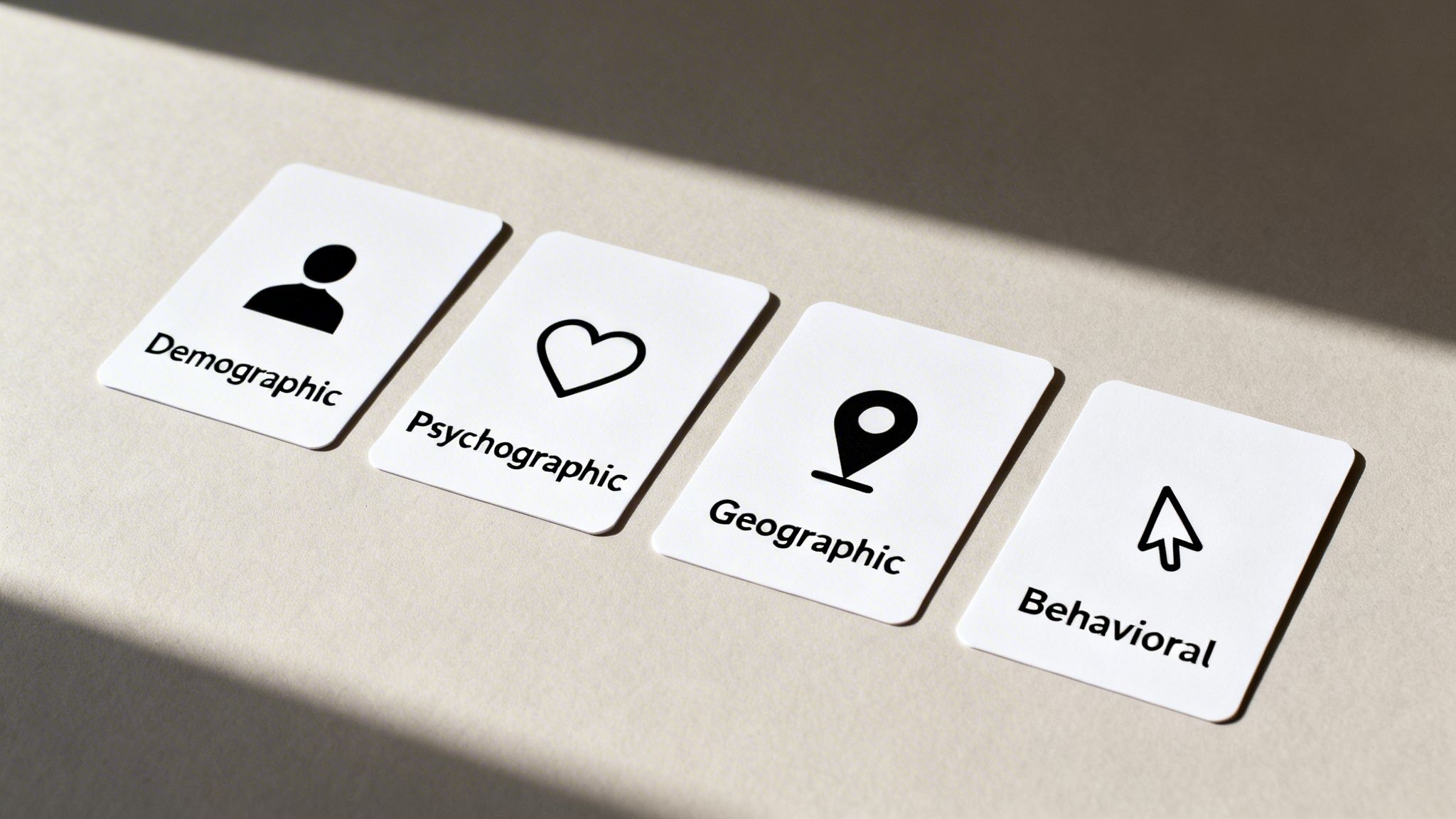
Sorting your audience feels like arranging puzzle pieces. Each piece—Demographic, Psychographic, Geographic, Behavioral—reveals a distinct image of who your customers really are.
Think of these four pillars as different lenses. One lens highlights who they are, another zooms into why they buy, a third pinpoints where they live, and the last tracks how they behave. Together, they form a roadmap for messaging that resonates.
Demographic Segmentation: Who Are Your Customers
Demographic Segmentation is your go-to when you need clear, quantifiable snapshots of your audience. It answers the simple “who” but also digs deeper into meaningful categories.
Key factors include:
- Age: Tailor products for Gen Z or Baby Boomers. A skincare shop might push wrinkle creams to 40+ shoppers while highlighting acne treatments for under-25s.
- Gender: Crucial in fashion, personal care, and gift markets.
- Income Level: A high-end brand targets affluent households, whereas a budget retailer speaks to price-conscious buyers.
- Life Stage: New parents, college students, retirees—all have unique needs and spending habits. On Shopify, tapping into the “new parent” niche can be a game-changer. Promoting baby gear, soothing lotions, or organizational tools becomes much more compelling when you know they’re juggling diaper runs and midnight feedings.
Geographic Segmentation: Where Are Your Customers
Geographic Segmentation maps out your audience by location, from countries down to neighborhoods. It ensures your offers feel local, timely, and relevant.
Practical uses:
- Adjust product recommendations by climate—coats for snowy areas, umbrellas in rainy zones.
- Offer free local delivery or in-store pick-up to boost community loyalty.
- Run geo-targeted ads around regional holidays or events.
Psychographic Segmentation: Why Do They Buy
Moving from “who” and “where” to “why” brings us to Psychographic Segmentation. This layer uncovers customers’ values, passions, and lifestyles.
Consider these dimensions:
- Values and Beliefs: Eco-minded shoppers respond to recyclable packaging or fair-trade sourcing.
- Lifestyle: Fitness buffs, homebodies, jet-setters—each group craves products that fit their daily routines.
- Interests and Hobbies: Knitters want new patterns and tools; gamers look for the latest accessories. Crafting messages that speak to these inner drivers builds a stronger bond than facts and figures ever could.
Behavioral Segmentation: How Do They Act
Behavioral Segmentation focuses on real actions—your most reliable data. It’s the engine that powers conversions and loyalty initiatives.
For detailed tactics, check out these practical examples of customer segmentation.
Top behavioral slices include:
- Purchase History: Recommend accessories based on past buys to boost cross-sells.
- Engagement Level: Send re-engagement emails to visitors who browse often but don’t purchase.
- Customer Loyalty: Reward repeat buyers or VIPs with exclusive discounts.
- Cart Abandoners: Nudge them back with a reminder or a small incentive. When you blend all four segmentation types, your audience portrait shifts from blurry to crystal-clear. That clarity lays the groundwork for a marketing strategy that truly speaks to each customer’s unique journey.
How Segmentation Drives Real Shopify Growth
Knowing the different types of segmentation is one thing. But seeing how it actually makes you money? That’s the real game-changer. This isn’t just about neatly organizing your customer list; it’s a powerful engine for growing your Shopify store’s bottom line.
When you stop blasting everyone with the same message, you start building a smarter, more resilient business. Each segment you create is a new opportunity to send the perfect message at the right moment, turning casual browsers into loyal customers.
Boost Your Conversion Rates
The first and most obvious win you’ll see from smart segmentation is a jump in your conversion rates. When your offers and messaging are tailored to specific groups, the journey from “just looking” to “just bought” gets a whole lot shorter.
Picture this: a shopper has visited your store three times, eyeing the same high-end jacket but never pulling the trigger. Instead of sending them a generic “10% off storewide” coupon that might get ignored, you can target them with a specific, compelling offer on that exact jacket. Suddenly, the message feels less like an ad and more like a helpful nudge.
This focused approach takes the guesswork out of marketing. You’re no longer just hoping your message resonates—you’re making sure it speaks directly to a person’s specific needs.
Enhance Customer Lifetime Value
Segmentation is also your secret weapon for building lasting customer relationships. By identifying your best customers—your repeat buyers, your high-spenders—you can roll out the red carpet and turn them into lifelong fans. This is how you increase their customer lifetime value (LTV).
Think about creating a “VIP” segment for anyone who has spent over a certain amount in your store. You can reward this group with perks that make them feel special, like:
- Exclusive early access to new collections before anyone else.
- Special discounts that aren’t available to the general public.
- Personalized “thank you” notes that show you appreciate their business. Actions like these make your best customers feel seen and valued, giving them every reason to stick with you. A loyal customer isn’t just someone who buys again; they’re someone who will spend more over time and won’t be tempted away by a competitor’s sale.
Improve Marketing Campaign Performance
Are your email open rates looking a little sad? Watching your unsubscribe numbers slowly tick up? Segmentation is the fix. Nothing makes people tune out faster than irrelevant content. On the flip side, sending messages that actually align with a segment’s interests keeps them engaged and ready to act.
For example, let’s say you have a group of customers who have only ever bought your eco-friendly products. When you launch a new sustainable item, you can send a targeted campaign just to them. The results speak for themselves: higher open rates, more clicks, and fewer unsubscribes, all because you sent them something they genuinely care about.
This strategy can also help you spot brand-new market opportunities. Did you know the secondhand fashion and luxury market is growing up to three times faster than the firsthand market? Insights like these, which you can read more about in recent findings on the state of fashion, show how precise segmentation can uncover new audiences. And with over 78% of retail site visits now happening on smartphones, pairing these campaigns with a mobile-first checkout is non-negotiable. It’s all about refining your approach to build a healthier, more profitable marketing machine.
Activating Your Segments with Checkout Links
Identifying your customer segments is the foundational strategy. Now, it’s time to put that knowledge into action and turn those insights into real sales. This is where theory hits the pavement. A perfectly defined segment is only valuable if you can actually reach it with a compelling offer, and Checkout Links gives you the tools to do exactly that.
Think of your segments as different groups of people at a party. You wouldn’t give the same speech to your closest friends as you would to new acquaintances. Checkout Links are your way of walking up to each group—your VIPs, first-timers, or deal-seekers—and starting a conversation meant just for them.
Create Targeted Discounts with Dynamic Links
One of the most effective ways to engage a segment is with a tailored discount. Your ‘VIP Customer’ segment, for example, deserves more than a generic 10% off coupon code anyone can use. You need to reward their loyalty and make them feel genuinely special.
With Dynamic Links, you can craft a unique checkout experience just for them. This isn’t a code they have to copy and paste; it’s a seamless link that automatically applies their exclusive discount at checkout.
- Scenario: You want to give your top 100 customers an exclusive 25% discount on your new collection.
- Action: Create a Dynamic Link with that 25% discount built right in.
- Result: Send this link directly to your VIP segment via email. They click, the discount is instantly applied, and they feel recognized. This reinforces their loyalty and makes the whole experience feel premium. This direct approach removes all friction. It’s a simple but powerful way to show your best customers you see them and appreciate their business.
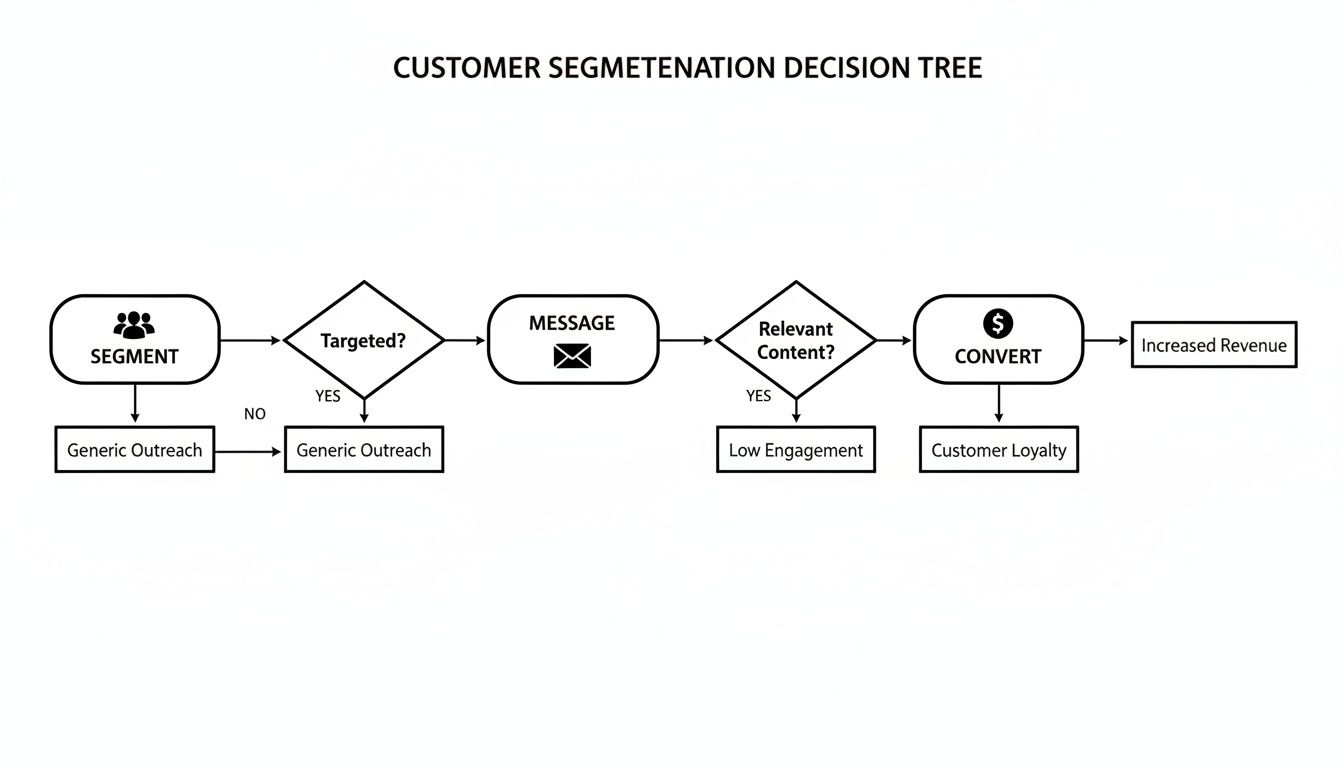
This visual shows how simple the process is: group your audience, deliver a relevant message, and drive the conversion.
Protect Exclusive Offers with Passcode Protection
Sometimes, an offer is so special it needs to be guarded. For a ‘High-Value’ segment or a tight-knit group of early adopters, you might want to protect a product launch or a limited-time deal from the general public.
Passcode Protection adds a layer of security, turning a standard link into a private entryway. Only customers who have the passcode can get to the checkout, creating a powerful sense of being in an inner circle.
Imagine you’re launching a limited-edition product. You can email your ‘High-Value’ segment the link along with an exclusive passcode. This ensures only they can buy it, which not only drives sales but also deepens their connection to your brand.
Discover What Converts with A/B Testing
What works for one segment might fall flat with another. Your ‘First-Time Buyer’ segment, for instance, is likely motivated by different incentives than your loyal repeat customers. A/B testing with Checkout Links lets you stop guessing and start using data.
You can easily create two different offers for the same segment and see which one actually performs better.
- Test A: A link offering 15% off their first order.
- Test B: A link offering free shipping on their first order. Send Link A to half of your ‘First-Time Buyer’ segment and Link B to the other half. By tracking the conversion rates on each link, you’ll get definitive proof of what truly motivates new customers to click “buy.” That’s gold for optimizing all your future campaigns.
To reach these customer groups beyond your own channels, learning about tools for effective Google Ads audience targeting is a great next step to expand your reach.
Schedule Flash Sales for Deal Seekers
Your ‘Deal Seekers’ segment is always on the hunt for a great bargain. Using the scheduling features in Checkout Links, you can plan flash sales with pinpoint precision, building excitement and driving a huge surge in orders.
You can create a link with a steep discount—say, 40% off select items—and schedule it to activate only for a specific 24-hour window.
To help you put this all into practice, here’s a quick-reference table showing how to match your segmentation goals with the right Checkout Links feature.
Checkout Links Features for Targeted Segmentation
| Segmentation Goal | Checkout Links Feature | Practical Use Case Example |
|---|---|---|
| Reward loyal VIPs | Dynamic Links | Send a direct link with an automatic 25% discount to your top customer list. |
| Create exclusivity | Passcode Protection | Gate a limited-edition product launch so only specific customers can access the checkout. |
| Optimize offers | A/B Testing | Test whether free shipping or 15% off converts better for first-time buyers. |
| Drive urgency | Scheduling | Set up a 24-hour flash sale link that activates and expires automatically for your deal-seekers. |
As you can see, each feature gives you a practical way to execute your segmentation strategy, turning abstract groups into tangible sales opportunities.
You can announce the flash sale to your ‘Deal Seekers’ in advance, knowing the link will automatically work when the sale begins and stop working when it ends. This automation creates real urgency and drives immediate action. For more ideas on getting your links out there, check out our guide on how to send links for maximum impact.
By combining these features, you can build a smart, multi-faceted strategy that speaks directly to each of your key customer segments. This is how you transform a marketing concept into a revenue-driving machine for your Shopify store.
Measuring Performance to Refine Your Strategy
https://www.youtube.com/embed/i-HNJZeOOMY
Getting your first segmented campaigns out the door is a huge accomplishment, but the work doesn’t stop there. The real magic begins when you start listening to what the data is telling you. Lasting success comes from consistently measuring what works, figuring out what doesn’t, and fine-tuning your approach.
Think of it like a chef perfecting a new sauce. You don’t just toss all the ingredients in a pot and call it a day. You taste, you adjust, and you taste again until it’s just right. In marketing, your key performance indicators (KPIs) are your taste tests—they tell you exactly what’s hitting the mark and what needs a little tweaking.
Key Metrics to Track for Your Segments
To really know if your strategy is paying off, you need to watch the right numbers. While different metrics matter for different segments, there are a few core KPIs that give you a solid read on performance across the board.
- Conversion Rate: This is the bottom line—did they buy? Tracking this for each segment shows you which groups are most responsive. If an A/B test for your ‘First-Time Buyer’ segment leads to a high conversion rate, you’ve found a winning offer.
- Average Order Value (AOV): Are certain segments spending more per checkout? If your ‘High AOV’ segment is consistently delivering on its name, your upselling and cross-selling tactics for that group are probably on point.
- Customer Lifetime Value (LTV): This one is all about the long game. It’s crucial for understanding profitability over time. Your ‘VIP Customer’ segment should have a much higher LTV. If it doesn’t, it might be time to rethink your loyalty rewards.
- Purchase Frequency: How often do customers in a particular segment come back? If your ‘High AOV’ group has a low purchase frequency, you could test a loyalty program or a subscription offer to turn those big one-time purchases into a habit. Keeping an eye on these KPIs for each segment gives you real, actionable insights. It’s the difference between “I think this is working” and “I know this is working because the data says so.”
Making Data-Driven Decisions
Once you have the data, you can start making smarter marketing decisions. For example, if a campaign sent to your ‘Deal Seekers’ segment results in a high conversion rate but a low AOV, that’s not a failure—it’s a valuable insight. It confirms this group is all about the discount, not high-value bundles.
On the flip side, what if a link for a new premium product sent to your ‘High-Value’ segment gets plenty of clicks but very few conversions? The problem might not be the audience; it could be the price point or even the product page itself. This data points you directly to where you need to focus your optimization efforts.
The Rise of AI in Dynamic Segmentation
This cycle of measuring and refining is only getting more powerful with today’s tools. Artificial intelligence is changing market segmentation from a static, reactive practice to a proactive, constantly adapting system. Experts see this shift as marking ‘the end of mass marketing and the beginning of personalized marketing on an individual scale.’
As you can explore in this report on global marketing trends, marketers are now moving from just building segments to a role of ‘supervision.’ They’re making sure that the AI-driven communication stays authentic and true to the brand’s voice. This means your segments can now adapt on the fly as customer behaviors and market trends change, keeping your strategy sharp without endless manual updates.
Common Segmentation Questions Answered
Diving into segmentation can bring up some practical questions. It’s one thing to grasp the concept, but applying it to your own Shopify store is a whole different ball game. Let’s clear up some of the most common questions and hurdles merchants face when they start this journey.
How Many Segments Are Too Many?
There’s no magic number here. For a small or growing store, a great starting point is 3-5 core segments. Just focus on the groups that will give you the most impact right out of the gate.
Honestly, it’s much better to have a few well-defined segments you can actually market to effectively than a dozen you can’t manage. As you get more comfortable and gather more data, you can always build out more specific sub-segments.
Once you’ve nailed your messaging for these core groups, then you can get more granular. For example, you might split your ‘Repeat Customers’ into ‘Occasional Buyers’ and ‘Brand Loyalists’.
The Difference Between a Segment and a Persona
This is a fantastic question, and the distinction is crucial for crafting your messaging. Think of it this way: a segment is the what and a persona is the who.
- Segment (The “What”): This is a broad group of customers defined by shared, concrete data points. For example, “customers who have spent over $200 in the last six months.” It’s the data-backed group.
- Persona (The “Who”): This is a fictional, detailed character you create to represent that segment. For the segment above, the persona might be “Luxury Larry,” a 45-year-old professional who values quality and isn’t price-sensitive. Segmentation gives you the analytical grouping, but the persona gives that group a human face. This is what helps your team create more empathetic and targeted messaging that truly connects.
Can I Start Without Much Customer Data?
Absolutely. You don’t need years of sales history to get started. Begin with the data you have, even if your store is brand new. Every single visitor and every single sale provides valuable information.
You can create powerful segments based on real-time behavior. For instance:
- Product Category Viewers: Group visitors who browsed a specific collection (like ‘Summer Dresses’) but didn’t buy anything. You can then retarget them with an ad or email focused on that exact category.
- Welcome Discount Users: Segment customers who made their first purchase using your welcome offer. This tells you they’re receptive to promotions right from the start. Another smart tactic is to use simple on-site surveys or quizzes. Ask your audience directly about their preferences, hobbies, or what they’re shopping for. The key is to start simple and let your segments become more sophisticated as your data grows.
How Often Should I Update My Segments?
Customer behavior is always changing, so your segments should never be set in stone. As a general rule, it’s a good practice to review your primary segments quarterly.
During this review, look at the data and ask some key questions. Is a particular segment growing or shrinking? Has the average order value for a group changed? Are they buying different types of products? This regular check-in helps you spot new trends and adapt your strategy.
For example, you might notice a new “Gift Giver” segment emerging around the holidays, which would prompt a new, temporary marketing campaign. While dynamic tools help you adjust in real-time, a formal review every 3-4 months ensures your overall strategy stays perfectly aligned with your customer base.
Ready to turn these answers into action? With Checkout Links, you can create targeted offers for every segment you define—no coding or complex setup needed. Start building smarter campaigns and watch your conversions grow. Create your first personalized Checkout Link today.