So, what exactly is customer lifecycle management? At its core, CLM is the process of understanding and guiding a customer’s entire journey with your brand. It’s about looking past that initial purchase to build a real, lasting relationship that drives long-term growth for your Shopify store.
Why Customer Lifecycle Management Matters
Picture your business as a garden. You could spend all your time frantically planting new seeds—that’s customer acquisition. But if you neglect to water and care for the sprouts already pushing through the soil, your garden will struggle to thrive. Customer lifecycle management is simply the art of nurturing those existing customer relationships.
This represents a major shift in thinking. Instead of pouring all your resources into finding new buyers, you create a balance. You’re still acquiring customers, of course, but you’re just as focused on keeping the ones you have happy, engaged, and excited to shop with you again. This balanced strategy is what separates fleeting success from sustainable growth.
From One-Time Buyers to Loyal Fans
Every single customer takes a unique path with your brand. That path, which we can break down into several key stages, is the very foundation of CLM. When you know where a customer is on their journey, you can connect with them with the perfect message at just the right moment.
This isn’t about blasting everyone with the same generic email. It’s about personalizing the experience to gently guide a curious visitor into becoming a passionate advocate for your products. This mindset helps you see the bigger picture—not just single sales, but the entire lifetime value each customer represents.
A Growing Priority for Modern Brands
For a long time, marketing departments were almost completely fixated on acquisition. But the tide is definitely turning as more and more businesses wake up to the incredible power of customer retention.
That old gap between acquisition and retention is closing fast. Right now, about 60% of teams prioritize acquisition, while 45% prioritize retention—a huge change from just a few years ago. The smartest companies are even creating dedicated lifecycle teams and shifting their budgets toward keeping existing customers. It’s a direct response to a demand from leadership for smarter, more efficient growth. You can dive deeper into these customer success trends to see how the industry is evolving.
By putting a customer lifecycle framework in place, you build a much more resilient business. You’ll create a company that thrives on genuine customer loyalty, not just the costly and exhausting cycle of constantly replacing lost customers. It’s how you build predictable, sustainable revenue for your Shopify store.
Mapping the Five Stages of the Customer Journey
To really get a handle on customer lifecycle management, you need a clear map of the journey your customers take. Think of it as a roadmap with five key destinations, each one a critical stage in your relationship with them. When you understand the purpose of each stop, you can meet your customers exactly where they are with the right message and the right experience.
This diagram shows the simple but powerful flow from first contact to lasting loyalty.
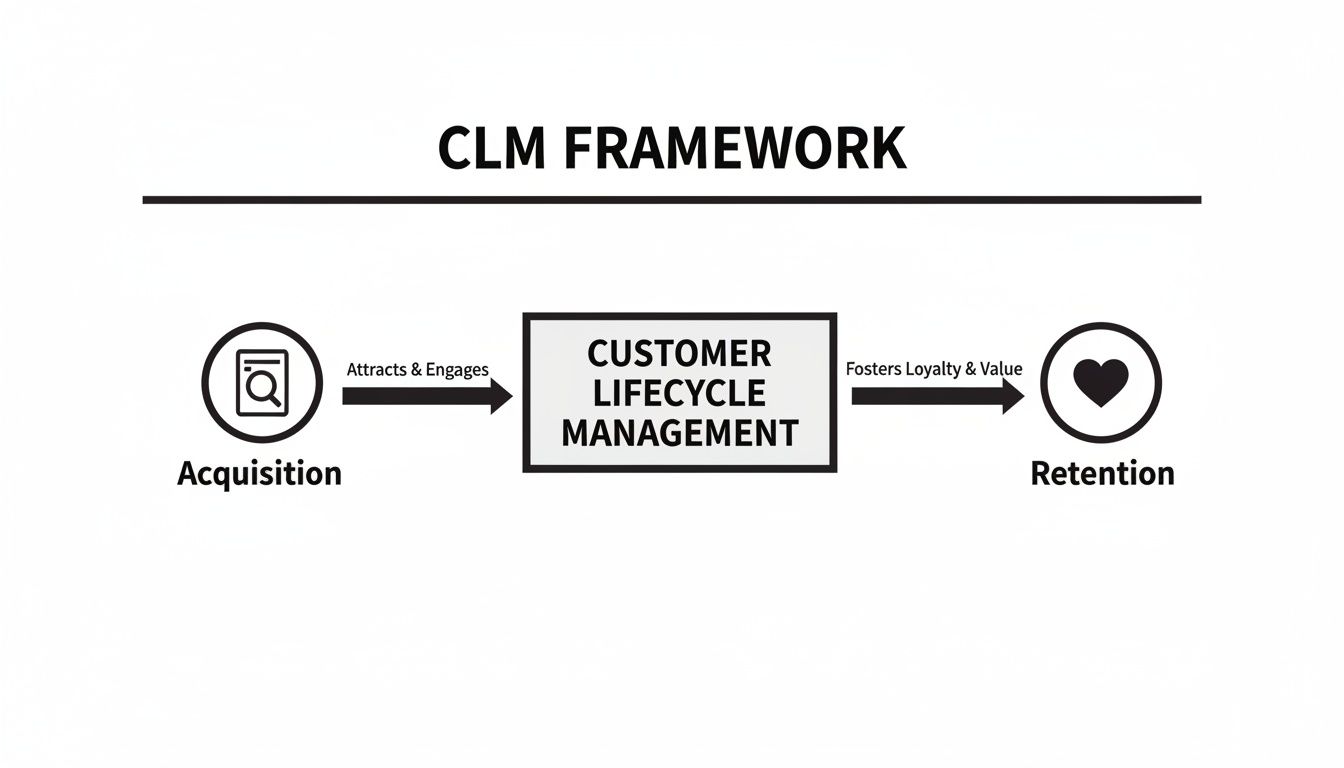
As you can see, the real shift here is from just acquiring a customer to actively keeping them around. It turns the old one-way funnel into a continuous, profitable cycle.
Let’s break down each of these five stages and the metrics you should be watching.
Stage 1: Reach
This is the very first “hello.” It’s where a potential customer becomes aware that your brand even exists. They might stumble upon an Instagram ad, read a blog post you wrote, or hear about you from a friend.
The main goal here isn’t to sell. It’s simply to grab their attention and make a strong first impression. Your focus should be on building brand awareness and driving the right kind of traffic.
Key Performance Indicators (KPIs) to watch:
- Impressions and Reach: How many people are actually seeing your content?
- Website Traffic: Are people making it to your Shopify store?
- Click-Through Rate (CTR): Is your content compelling enough to earn a click? For example, a low CTR could mean your ad creative isn’t connecting with your target audience, signaling it’s time for a refresh.
Stage 2: Acquisition
In the acquisition phase, a visitor starts showing real interest. They’re no longer just aware of you; they’re actively considering what you offer. This is the point where they might subscribe to your newsletter, follow you on social media, or even add an item to their cart.
Metrics to track are all about lead generation and engagement:
- Email or SMS Subscribers: How many people have opted into your marketing?
- Social Media Follower Growth: Are you building a genuine community?
- Add to Cart Rate: Are shoppers showing clear intent to buy?
Stage 3: Conversion
This is the big moment—the first purchase. The customer now trusts your brand enough to pull out their credit card and complete the transaction. For any Shopify store, making this step as smooth and easy as possible is absolutely essential.
Your main job is to turn that interested prospect into a paying customer. The most important KPI is your Conversion Rate, which is the percentage of visitors who buy something. Other numbers like Average Order Value (AOV) and Cart Abandonment Rate tell a huge part of the story, too. A high cart abandonment rate, for instance, is a massive red flag that something in your checkout process is causing problems.
Stage 4: Retention
The journey doesn’t end with the sale. In many ways, it’s just getting started. The retention stage is all about encouraging that first-time buyer to come back for a second purchase, and then a third. This is where you begin to build a real relationship. For online stores, mastering e-commerce customer service is a non-negotiable part of this stage.
Here, you need to create an amazing post-purchase experience and nurture that brand-new customer relationship.
Critical KPIs include:
- Customer Retention Rate: What percentage of customers buy from you again?
- Repeat Purchase Rate: How often do existing customers come back to buy?
- Purchase Frequency: How many times does a typical customer buy from you in a year?
Stage 5: Loyalty
The final stage is loyalty. This is where customers become more than just repeat buyers—they become true fans and advocates. They choose your brand without a second thought, spend more over time, and rave about you to their friends and family. This is the ultimate prize in customer lifecycle management.
Your objective is to turn happy customers into loyal brand ambassadors. The gold-standard metric here is Customer Lifetime Value (CLV), which tracks the total revenue a single customer brings to your business over their entire relationship with you. You should also keep an eye on your Net Promoter Score (NPS) to see how willing customers are to recommend you.
If you’re interested in digging deeper into this framework, our article on the customer journey stages offers even more insight.
Using AI and Automation to Enhance Your CLM Strategy
Trying to manage every customer’s journey by hand is like attempting to have a meaningful, one-on-one conversation with every single person at a packed stadium. It’s just not going to happen. This is exactly why AI and automation have become essential, turning customer lifecycle management from a constant, reactive scramble into a smart, proactive growth strategy.
Think of AI as your sharpest analyst, one that works around the clock. It tirelessly combs through mountains of customer data—purchase histories, browsing habits, email engagement—to uncover subtle patterns and trends that a human team could easily miss. This opens the door to powerful strategies that, not long ago, were only available to enterprise-level giants.
The Power of Predictive Insights
One of the most significant breakthroughs AI offers is predictive segmentation. Instead of just grouping customers based on what they’ve already done, AI can forecast what they’re likely to do next. It can pinpoint which new visitors have the highest potential to become your best customers or—just as importantly—which loyal shoppers are starting to show signs of churn.
This allows you to step in before a customer is lost for good. For example, an AI tool might flag a customer who hasn’t bought anything in 60 days but just spent ten minutes browsing a new collection. That’s your cue. An automated, personalized email with a small incentive for that specific collection can make all the difference.
This isn’t a futuristic concept; it’s happening right now. A staggering 85% of marketers are already using AI in their lifecycle marketing. As a testament to its power, one company saw a 72% increase in applications processed after automating its onboarding, which helped drive a 90% revenue jump. AI-powered segmentation, which uses real-time behavioral signals, is quickly becoming the new standard.
Automation as Your Always-On Assistant
If AI is the brains of the operation, then automation is the brawn. It’s the engine that carries out the intelligent tasks AI identifies, freeing you up to focus on the big picture. Automation takes over the repetitive, yet critical, work that can otherwise bog down your team.
Here’s how automation can put your CLM on autopilot:
- Welcome Series: Instantly greet new subscribers with a curated email sequence that tells your brand’s story and showcases top-selling products.
- Cart Abandonment: Automatically trigger a timed email or SMS to shoppers who left items behind, ideally including a link that takes them directly back to their pre-filled cart.
- Post-Purchase Follow-up: Send a thank you message, request a review, or share a discount for their next order—all without you lifting a finger. For a deeper dive, check out our guide on marketing automation for e-commerce to learn how to streamline your operations. And if you’re on Shopify, you can take it even further by Leveraging AI Apps For Shopify Store to personalize customer interactions at scale.
By combining the intelligence of AI with the efficiency of automation, you can deliver a responsive, highly personal experience for every customer at every stage. This isn’t just about saving time—it’s about building a smarter business that fosters genuine customer relationships and drives long-term, sustainable growth.
Putting CLM Into Practice with Checkout Links
Alright, so you’ve got the theory down. You understand what customer lifecycle management is. Now for the fun part: making it work for your store and actually driving results. It’s time to get our hands dirty and move from concepts to real-world strategies. For Shopify merchants, one of the most powerful and frankly underrated tools for this is a simple, shareable checkout link.
Think of Checkout Links as a shortcut to the cash register. Instead of sending a shopper to a product page and crossing your fingers they’ll click “add to cart” and then find their way to checkout, you send them straight to the finish line. This one small shift can have a massive impact on every single stage of the customer journey, from that first sale all the way to creating lifelong fans.
Let’s walk through three common scenarios and see exactly how you can use Checkout Links to launch powerful CLM campaigns—no developers or coding needed.
Scenario 1: Rescue Abandoned Carts (Conversion Stage)
We’ve all been there. Cart abandonment is the bane of e-commerce. A customer is so close—they’ve loaded up their cart, showing clear intent to buy, and then… poof. They vanish. Standard abandoned cart emails are a good start, but they often just link back to an empty cart page, making the person start all over again. A personalized checkout link completely changes the game.
The Goal: Make it ridiculously easy for a potential customer to finish their purchase by removing every possible obstacle.
Implementation with Checkout Links:
- Identify Abandoners: First, pull a list of everyone who abandoned a cart from your Shopify data or email marketing platform.
- Create a Dynamic Link: This is the magic step. Generate a checkout link that automatically repopulates the cart with the exact items the customer left behind.
- Add a Little Nudge: To make the offer irresistible, attach a unique, single-use discount code directly to that link—maybe 10% off or free shipping. It makes the offer feel exclusive.
- Deploy the Campaign: Send an email or SMS with a clear, direct call-to-action like, “Ready to complete your order?” When they click, they skip the product and cart pages entirely, landing right on the checkout page with their items and discount ready to go.
Scenario 2: Win Back Lapsed Customers (Retention Stage)
Every store has them: the “one-and-dones.” Customers who bought something once and then disappeared. Bringing these folks back is a core part of CLM, especially since it’s far cheaper than finding a brand-new customer. A generic “we miss you” email rarely works, but a personalized offer can be a powerful hook.
The Goal: Encourage a second purchase from a dormant customer by giving them a relevant and compelling reason to come back.
Implementation with Checkout Links:
- Segment Your Audience: Create a customer segment of people who bought once between 60 and 90 days ago but haven’t been back since.
- Craft a Personalized Offer: Look at what they bought the first time. Did they get a bag of coffee? A specific skincare product? Create a checkout link for a complementary item or a simple “refill” of their original purchase.
- Apply an Exclusive Discount: Generate a checkout link with a special “welcome back” discount that isn’t advertised anywhere else on your site.
- Launch the Win-Back Campaign: Send a targeted email that shows you remember them. Something like, “We saw you loved our coffee beans! Here’s a special 15% discount on our new single-origin roast, just for you.” This approach feels personal and thoughtful, not like a mass marketing blast. It shows you’re paying attention and offering real value, which is a fantastic way to bring them back into the fold and reignite the customer lifecycle.
Scenario 3: Reward Your VIPs (Loyalty Stage)
Your best customers are gold. They buy from you again and again, and they tell their friends about you. Treating them like the VIPs they are is the secret to cementing that loyalty and turning them into true brand evangelists.
The Goal: Make your most valuable customers feel special and appreciated with an exclusive offer that strengthens their connection to your brand.
Implementation with Checkout Links:
- Identify Your VIPs: Build a segment based on high lifetime value, number of orders, or total amount spent. You know who they are.
- Create an Exclusive Flash Sale: Dream up a special offer just for them. Maybe it’s early access to a new product or a steep discount on a premium item.
- Generate a Protected Link: Use Checkout Links to create a link for this deal. You can even add a passcode to it, so only your VIPs who have the “secret code” can get in.
- Announce the Exclusive Event: Email your VIP list and let them know about their exclusive access. The link takes them straight to the discounted checkout, reinforcing that feeling of being an insider and rewarding their loyalty. This strategy does more than just drive a few extra sales. It builds a powerful emotional connection. When customers feel like they’re part of an exclusive club, their loyalty deepens, and they’re far more likely to share their positive experiences—which, in turn, feeds new customers right back into the top of your lifecycle.
How to Measure and Optimize Your CLM Performance
You can have the best customer lifecycle management (CLM) strategy in the world, but if you can’t measure its impact, it’s just a guessing game. Simply launching campaigns and hoping for the best won’t cut it. You need to connect your actions to real, tangible outcomes that affect your bottom line.
https://www.youtube.com/embed/WgBSjb1ZcxY
The idea is to draw a straight, undeniable line from a specific action to a measurable result. For example, if you launch a cart recovery campaign with personalized Checkout Links, you should see your cart abandonment rate drop. When you send a special offer to your VIP customers, you should see a direct lift in their Customer Lifetime Value (CLV).
Connecting Actions to Key Metrics
To measure your CLM efforts properly, you need to tie your tactics to specific Key Performance Indicators (KPIs) for each stage of the customer journey. By tracking these numbers before and after you try something new, you can definitively prove what’s working and justify where you spend your time and money.
Here are a few examples of how to connect your actions to the right metrics:
- For Cart Recovery Campaigns: Watch your Cart Abandonment Rate and the Conversion Rate from your recovery messages. A winning campaign will push the first number down and the second one up.
- For Win-Back Offers: Keep an eye on the Repeat Purchase Rate for the group of lapsed customers you targeted. Did your offer actually convince them to come back and buy again?
- For Loyalty Programs: Zero in on Customer Lifetime Value (CLV) and Purchase Frequency for your most loyal customers. Are they buying more often and spending more money because of the perks you’re offering? This data-first approach takes all the guesswork out of marketing. It gives you the confidence to double down on what’s working and quickly scrap what isn’t, allowing you to systematically improve your results over time.
The Hidden Costs of Inefficiency
A lot of businesses, especially when they’re starting out, handle customer management manually. It might seem doable at first, but this approach comes with huge hidden costs—both in wasted time and lost revenue. Manually sorting customer lists, sending one-off emails, and trying to keep track of everything is not only incredibly time-consuming but also full of opportunities for human error.
The real cost, though, is the missed opportunity. While you’re tied up with busywork, potential customers are abandoning their carts and one-time buyers are forgetting your brand even exists. Smart automation completely flips that script.
The efficiency boost from a digital CLM system isn’t just a small bump; it can be massive. While the industry is different, just look at the financial sector. The traditional process for onboarding a new commercial customer can cost a staggering **20,000 to **30,000. By moving to a digital journey, Santander saw a 75% decrease in the effort required. Metro Bank automated its process and took the average case time from 200 minutes down to just 8 minutes—a 94% improvement. It’s clear that a new era of customer lifecycle management is changing how businesses operate.
For a Shopify store, this same principle translates into recovering more abandoned carts, converting more visitors, and keeping more customers, all without you having to work more hours.
Visualizing the Before and After
The difference between a manual approach and an automated CLM system is truly night and day. By bringing in tools that automate personalized communication, you can spark major improvements across your most important business metrics. The shift from manual to automated processes shows just how much efficiency and revenue are unlocked.
Here’s a look at the typical impact:
Impact of CLM Automation on Business Efficiency
| Metric | Manual Process (Before) | Automated CLM (After) | Improvement |
|---|---|---|---|
| Cart Abandonment Rate | 70% | 55% | -21% reduction in lost sales |
| Repeat Purchase Rate | 15% | 25% | +67% increase in repeat business |
| Marketing Team Hours | 20 hours/week | 5 hours/week | -75% decrease in manual work |
| Customer Lifetime Value | $150 | $225 | +50% increase in long-term customer value |
As the table clearly shows, putting a digital CLM system in place does more than just save time—it directly drives revenue and helps you build a much more valuable customer base. This “before-and-after” transformation is the ultimate reward for optimizing your customer lifecycle performance.
Ready to Get Started? Here’s Your Quick Implementation Checklist
Alright, let’s turn all this theory into action. It’s easy to feel fired up about customer lifecycle management, but the hardest part is often just getting started. This checklist is designed to break the whole process down into simple, manageable steps.
The goal here isn’t to rebuild your entire marketing strategy overnight. It’s about taking small, deliberate actions that create momentum. Think of it as building a flywheel—each small push adds up, eventually leading to significant, sustainable growth.
Your 5-Step Action Plan
Here’s a straightforward blueprint to put what you’ve learned into practice on your Shopify store and start seeing real results, fast.
- Map Your Customer Journey (The Quick and Dirty Version): Grab a whiteboard, a notebook, or even just a piece of paper. Sketch out the five core stages: Reach, Acquisition, Conversion, Retention, and Loyalty. Next to each one, jot down what that stage actually looks like for your business right now. You don’t need a masterpiece; you just need a simple visual to give you clarity.
- Pick One Stage to Focus On: This is key—don’t try to boil the ocean. Look at your map and choose the single area where you think you can make the biggest impact quickly. For most Shopify stores, the low-hanging fruit is usually in the Conversion stage (think abandoned carts) or early Retention (like getting that crucial second purchase).
- Launch One Targeted Campaign: Now it’s time to do something. If you picked cart recovery, use a tool like Checkout Links to create your first targeted campaign. Start small. Send a personalized email with a direct, pre-filled checkout link to a specific segment of shoppers who abandoned their carts.
- Set a Simple Success Metric: How will you know if your effort paid off? Before you hit “send,” decide on one key metric. For that cart recovery campaign, a great starting goal could be to recover 10% of abandoned carts from that specific group.
- Review and Iterate: Give it a week, then dive into your analytics. Did you hit your 10% goal? What did you learn from the results? Use those insights to decide your next move. Maybe you’ll tweak the email copy and run it again, or perhaps you’ll feel confident enough to tackle a new stage in the journey.
Common Questions About Customer Lifecycle Management
As you start thinking more deliberately about how you build relationships with your customers, a few questions are bound to come up. The idea of a formal customer lifecycle strategy can sound a bit complicated, but the core ideas behind it are actually pretty simple and incredibly powerful.
To help clear things up, we’ve pulled together answers to some of the most frequent questions we hear from Shopify merchants who are just starting to look at the entire customer journey.
Is CLM Only for Large Businesses?
Absolutely not. While giant corporations have entire teams dedicated to this stuff, customer lifecycle management is a strategy that works wonders for businesses of any size. For a new or small Shopify store, it can be as simple as setting up a great welcome email for new subscribers and a basic cart recovery flow.
The main idea—guiding customers from their very first visit to becoming loyal fans—is universal. Modern tools and automation have made it so you don’t need a massive budget or a big marketing department to get a great return. The trick is to start small and focus on the areas that will make the biggest difference first.
How Is CLM Different from a Marketing Funnel?
This is a really important distinction. A traditional marketing funnel is a one-way street, and its main job is to get that first sale. Once a customer buys something, the funnel’s work is pretty much done.
CLM is all about turning that one-time buyer into a happy, repeat customer and, ideally, a loyal advocate who tells their friends about you. The goal isn’t just a single transaction; it’s about maximizing the total value you get from every customer over their entire time with your brand.
Which Stage of the Lifecycle Should I Focus on First?
If you’re looking for the quickest and most noticeable impact, most Shopify stores should start with the “Conversion” and early “Retention” stages. These two spots are where you’ll often find the biggest opportunities for immediate revenue.
- Conversion: Improving your cart abandonment rate is like finding money you didn’t even know you were losing. It’s a huge win.
- Retention: Getting a new customer to come back for a second purchase is almost always cheaper and easier than finding a brand-new one from scratch. By zeroing in on these stages, you can score some quick wins. That not only helps your bottom line but also builds the momentum (and budget) to tackle more advanced lifecycle strategies later on.
How Quickly Can I Expect to See Results?
You can see positive results from certain CLM tactics almost right away. For instance, a well-crafted cart recovery campaign using personalized Checkout Links can start boosting your sales and winning back lost revenue within the first 24 hours after you launch it.
Of course, the bigger strategic goals will take more time to show. A real, measurable increase in your overall Customer Lifetime Value (CLV), for example, will need a few months of data to track accurately as you build that loyalty over several purchase cycles. The key is to mix those quick, measurable actions with your long-term relationship-building efforts.
Ready to put these ideas into practice? Checkout Links gives you the power to run smart customer lifecycle strategies with personalized, shareable checkout links. Recover abandoned carts, reward your VIP customers, and drive repeat purchases without the hassle.
Start optimizing your customer journey today at https://checkoutlinks.com.