E-commerce advertising is all about using paid online channels—think social media, search engines, and marketplaces—to bring the right people to your online store and, most importantly, turn them into customers. It’s more than just running ads; it’s about building a reliable system that generates sales.
Why Most E Commerce Advertising Fails and How Yours Can Succeed
Ever feel like you’re just throwing money at ads without seeing any real return? It’s a common frustration. Many online store owners pump cash into campaigns only to end up with a handful of clicks and impressions, but no meaningful sales.
The problem isn’t getting noticed; it’s converting that attention into actual revenue. Success in e-commerce advertising comes from creating a smooth, connected path that guides a shopper from the moment they see your ad all the way to the “thank you for your order” page.
This guide will walk you through building that kind of profitable advertising machine. We’ll break down the core pieces of a winning strategy so you can make every dollar you spend work for you.
Building a Strong Foundation
Today’s shoppers are everywhere. They might spot your product on TikTok, look up reviews on Google, and finally buy after a retargeting ad catches their eye on Instagram. This scattered journey is exactly why a “spray and pray” approach just doesn’t work.
A solid strategy starts with understanding a few key things:
- Your Core Channels: Figure out where your ideal customers actually hang out. Are they searching on Google, scrolling through social feeds, or shopping directly on Amazon?
- Your Customer’s Intent: There’s a big difference between someone actively searching for a solution (e.g., “buy waterproof running shoes”) and someone just browsing for inspiration. Your ads need to speak to both.
- Your Financial Metrics: You have to know your numbers. What does a profitable sale look like? Get crystal clear on your customer acquisition cost (CAC) and return on ad spend (ROAS). For real, lasting success, your ad campaigns need to be part of broader effective ecommerce growth strategies that focus on keeping customers long after the first purchase.
The Mobile-First Imperative
Shopping on a phone isn’t a trend anymore—it’s the default. The numbers don’t lie. Global digital ad spending is projected to blow past $700 billion, and mobile ads now eat up over 70% of that budget.
Why? Because mobile users are more engaged. In fact, they’re twice as likely to click on an ad compared to someone on a desktop. This means everything you do, from your ad creative to your checkout process, absolutely must be optimized for a flawless mobile experience.
Choosing Your Core Advertising Channels
Diving into e-commerce advertising can feel like you’ve been dropped in the middle of a bustling city with no map. Signs are pointing everywhere—Google, Facebook, TikTok, Amazon—and you have to decide which way to go first.
The secret isn’t picking just one path. It’s understanding that each channel is a different tool for a different job. Your mission is to pick the right combination to build a solid, profitable business.
A great way to think about this is breaking your strategy into two main jobs: capturing existing demand and creating new demand. Some people are already out there searching for exactly what you sell. Others have no idea your product exists, but they’d love it if they did. The best brands become masters of both.
This chart breaks down how your ad budget, your strategy, and your sales all connect.
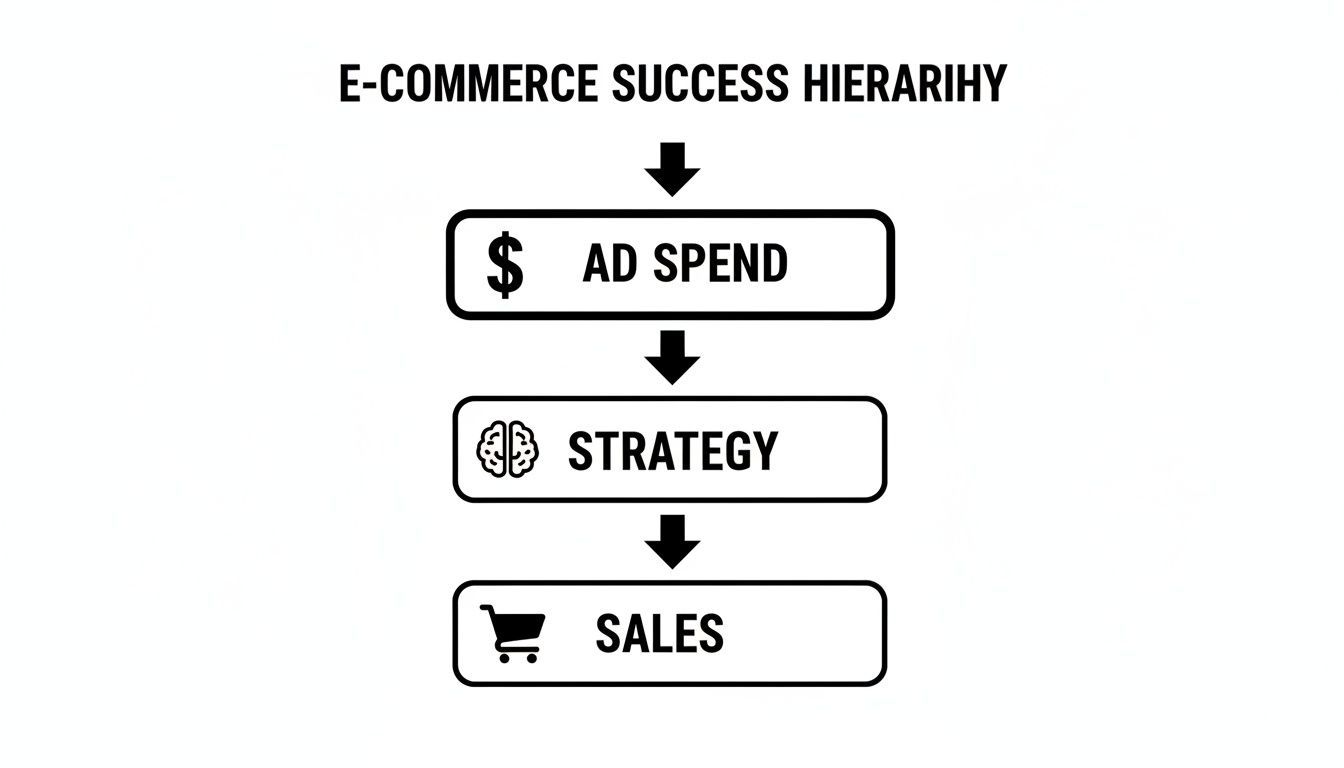
As you can see, just throwing money at ads won’t cut it. A smart strategy is the bridge that turns your investment into actual revenue.
Paid Search: The Demand Capturers
When you need to find customers with high intent, paid search platforms are your best friend. Google Ads is the undisputed king here.
Think about it. These are people actively typing “buy organic dog food online” or “best noise-cancelling headphones” into a search bar. They have a problem, and they’re looking for a solution right now. That solution could be your product.
This is what makes search ads so powerful. You aren’t interrupting their day; you’re showing up with an answer at the exact moment they need it most. For e-commerce brands, Google Shopping Ads are a game-changer, putting your product image, price, and store name right at the top of the search results. To get the most out of these high-intent clicks, you’ll need a solid approach to PPC campaign management.
Paid Social: The Demand Creators
If search is all about capturing demand, paid social is where you create it. Platforms like Meta (Facebook and Instagram) and TikTok are discovery engines. People are there to scroll, be entertained, and connect with friends—not necessarily to shop.
Your job is to stop that scroll. You need compelling visuals and messaging that grab their attention, introduce your brand, and spark a desire they didn’t even know they had. This is how you build brand awareness and tap into completely new audiences.
You can target users based on a huge range of factors:
- Interests and Hobbies: What pages do they like? What kind of content do they engage with?
- Demographics: Age, location, gender, and more.
- Behavioral Data: Past purchases or interactions with brands like yours. With global e-commerce sales projected to reach $7.5 trillion by 2025, reaching the world’s 2.77 billion online shoppers through these platforms is a massive opportunity. And video is key—a full 78% of online consumers prefer short-form videos to discover products, making channels like TikTok and Instagram Reels absolutely essential.
Marketplace Advertising: Winning at the Point of Purchase
Advertising on marketplaces like Amazon or Walmart is all about winning the final yards. Shoppers on these sites are already in a buying mindset. Their credit card is saved, they’re logged in, and they’re ready to click “buy.”
Running ads here is the digital equivalent of paying for prime shelf space at the supermarket. You’re putting your product directly in front of motivated buyers who are actively searching within that specific ecosystem. The focus here is less on telling a grand brand story and more on pure visibility, competitive pricing, and glowing customer reviews.
In the end, the best e-commerce advertising strategy is never about just one channel. It’s about building a complementary system where each platform plays to its strengths, guiding customers smoothly from initial discovery all the way to checkout.
Developing Ads That Actually Convert

Great e-commerce advertising isn’t some dark art; it’s a disciplined process of getting the right message in front of the right person. A beautiful ad shown to the wrong audience is a waste of money. So is a sloppy ad, even if you show it to your perfect customer. To win, you have to master two things: laser-focused targeting and creative that actually stops the scroll.
Let’s start with finding your people. Too many brands stop at basic demographics like age and location. That’s a decent first step, but it’s like casting a giant net in the ocean. Sure, you’ll catch something, but most of it won’t be what you’re looking for.
Mastering Precision Targeting
Real targeting digs much deeper. It’s about understanding what people do, what they love, and who they are connected to, all to find an audience that’s ready to buy. When you move past the basics, you’ll see your ad performance jump and your acquisition costs drop.
Here are a few powerful ways to find your ideal audience:
- Behavioral Targeting: This is all about action. You can target people based on what they do online—visiting specific product pages, engaging with brands like yours, or making recent purchases in a similar category.
- Lookalike Audiences: This is easily one of the most powerful tools out there. Platforms like Meta let you upload a list of your best customers, and their algorithm goes out and finds new people who “look” just like them online. It’s like cloning your top buyers.
- Retargeting: Let’s be honest, most people don’t buy on the first visit. Retargeting lets you serve specific ads to people who have already browsed your site but left without making a purchase. These are warm leads just waiting for a little nudge.
By combining these methods, you create a complete targeting playbook. Use lookalikes to find brand-new customers, and then use retargeting to bring back the ones who got away. This way, every dollar is spent on people who are much more likely to convert.
Crafting Creative That Captures Attention
Okay, so you’ve found your audience. Now, how do you get them to care? Your creative—your visuals and your copy—has just a split second to make an impact in a crowded feed. The goal isn’t just to get attention but to create a seamless experience from the ad to the landing page.
One of the biggest mistakes I see is a jarring disconnect between the ad and what comes next. If your ad promises 50% off a specific blue sweater, that link better drop them directly onto a page with that blue sweater, discount applied. Making them hunt for the product or enter a code is a surefire way to lose the sale.
Keep your ad copy clear, punchy, and focused on the benefit. Don’t just list features; tell them how your product solves a problem or makes their life better. Use strong action words and a crystal-clear call-to-action (CTA) like “Shop Now” or “Claim Your Discount.”
Finally, never set it and forget it. Embrace A/B testing to constantly improve. Test one thing at a time—the headline, the image, the CTA button—and let the data tell you what’s working. This simple, data-backed approach transforms advertising from a guessing game into a reliable growth engine.
Measuring What Matters to Prove ROI
Pouring money into e-commerce ads without a way to measure the impact is a surefire way to burn through your budget. It’s like flying a plane blind—you’re moving, but you have no idea if you’re actually heading toward your destination. To know if your ads are profitable, you have to look past vanity metrics like simple clicks and impressions and zero in on the numbers that tie directly to your bottom line.
Think of your ad data as the story of your business’s financial health. Your goal isn’t just to get a bunch of clicks; it’s to win over new customers at a cost that makes sense and keeps them coming back for more. This is how you shift from just spending money on ads to strategically investing it.
When you track the right data, you can finally answer the million-dollar question: “Is my advertising actually making me money?”
Core Metrics for E Commerce Success
To get a clear picture of your advertising performance, you need to get comfortable with a few key metrics. These aren’t just buzzwords; they’re the vital signs of your online store’s health.
- Return on Ad Spend (ROAS): This is the ultimate yardstick for ad profitability. It tells you exactly how much revenue you earn for every single dollar you put into ads. A ROAS of 4:1, for example, means you’re making **4 for every **1 spent.
- Customer Acquisition Cost (CAC): This metric tells you precisely how much it costs to bring one new customer through the door via your advertising. A low CAC is great, but it’s only half the story—you have to compare it to how much that customer will spend over time.
- Customer Lifetime Value (LTV): This is the total amount of money you can realistically expect a single customer to spend with your brand over their entire relationship with you. A high LTV gives you more room to spend on acquiring that customer in the first place.
Essential E Commerce Advertising Metrics
Let’s break down the most important metrics you should be watching. Tracking these numbers in a simple dashboard will give you an at-a-glance view of what’s working and what’s not.
| Metric | What It Measures | Why It Matters |
|---|---|---|
| ROAS | Total revenue generated from ads divided by the total ad spend. | Shows the direct profitability of your campaigns. A high ROAS means your ads are efficient money-makers. |
| CAC | Total ad spend divided by the number of new customers acquired. | Reveals the cost to get a new customer. Essential for ensuring your marketing is sustainable. |
| LTV | The predicted total revenue a single customer will generate over time. | Puts CAC into context. A high LTV justifies a higher acquisition cost. |
| Conversion Rate (CVR) | The percentage of ad clicks that result in a desired action (e.g., a purchase). | Measures the effectiveness of your ad creative, copy, and landing page at persuading people to act. |
| Cost Per Click (CPC) | The average amount you pay for a single click on your ad. | Helps you understand the cost of traffic and manage your ad budget on platforms like Google and Meta. |
| Click-Through Rate (CTR) | The percentage of people who saw your ad and actually clicked on it. | Indicates how compelling and relevant your ad is to your target audience. A low CTR can signal a problem. |
By keeping an eye on these core numbers, you can move beyond guesswork and start making decisions based on cold, hard data.
Understanding Attribution
Attribution can feel like one of the trickiest parts of e-commerce advertising, but the idea behind it is pretty straightforward. It’s all about giving credit where credit is due. Did a customer make a purchase after seeing a Facebook ad, clicking a Google search result, or opening an email? Attribution tries to answer that.
Most platforms use an “attribution model” to decide which ad gets the credit. For instance, a common “last-click” model gives 100% of the credit to the very last touchpoint a customer interacted with before buying. Knowing which model your ad platform uses is crucial for accurately judging which campaigns are truly driving sales.
To track all this effectively, you need a solid foundation. Using UTM parameters in your ad links is non-negotiable. This simple tagging system tells your analytics software exactly where each visitor came from, giving you clean, clear data to analyze. To get this set up correctly, you can learn more about UTM tracking best practices in our guide. It’s the key to stopping the guesswork and starting to make confident, data-backed decisions that prove your advertising’s value.
Connecting Your Ad Click to an Instant Sale
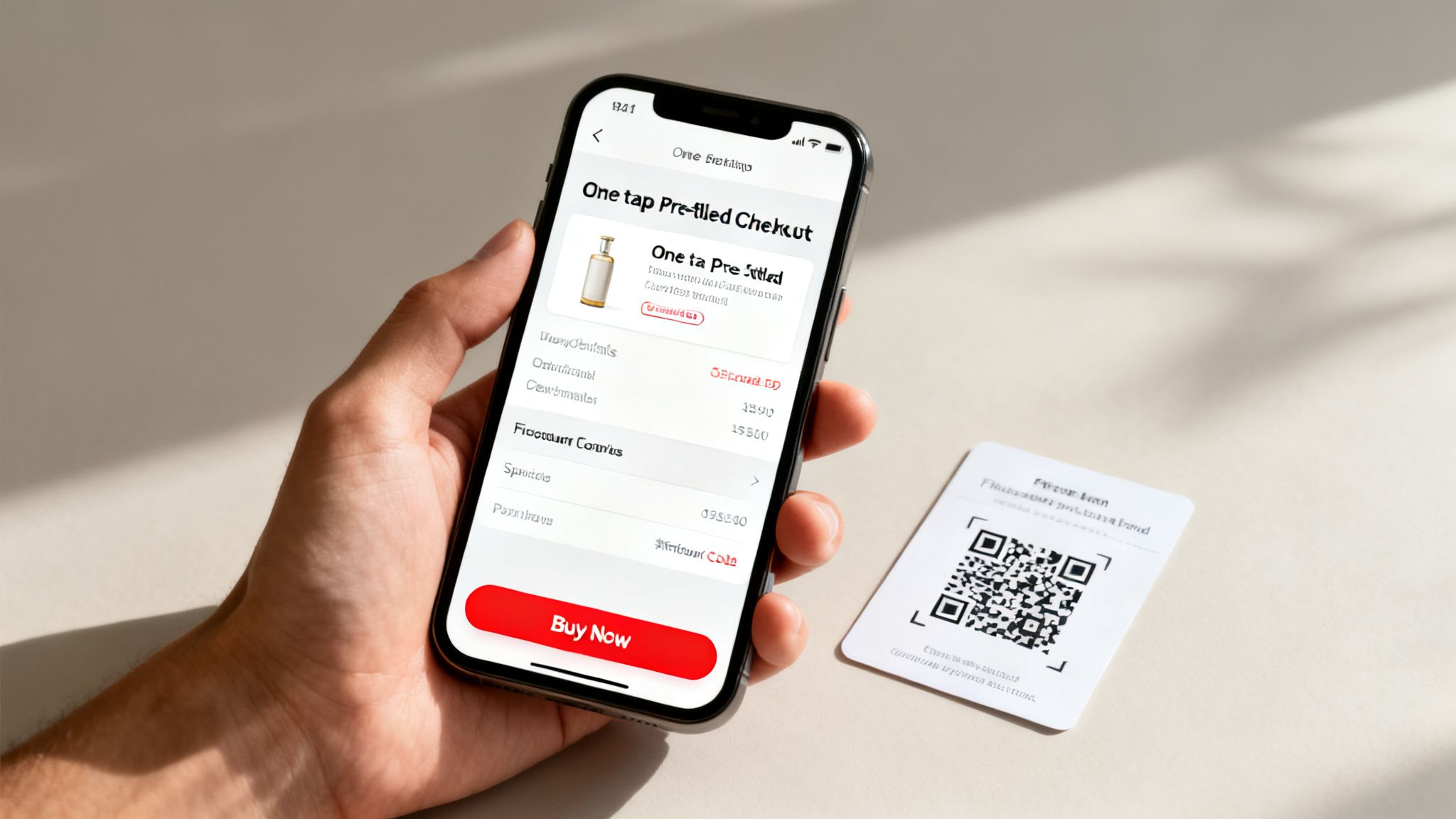
The path from a hopeful ad click to a completed sale is a minefield. That tiny window of opportunity is where even the slightest bit of friction—one extra form field, a forgotten discount code, a confusing product page—sends potential customers running for the hills. This is precisely where a huge chunk of ad spend goes to die.
Great e-commerce advertising isn’t just about getting the click. It’s about making the purchase so effortless it feels automatic. You want to shrink the distance between “I want that” and “I bought that” until it’s practically zero. How? By ripping out every single step that isn’t absolutely essential.
From Ad to Checkout in a Single Tap
Think about this: your ideal customer sees a flash sale ad on their Instagram feed. They tap it. Instead of getting dumped on a generic homepage, they land directly on a checkout page with the product from the ad already in their cart. The promised discount is already applied. All they have to do is pay. This isn’t a dream—it’s the reality of using direct checkout links.
These aren’t just normal URLs. They’re specifically built to bypass the clunky, traditional shopping journey of find product > add to cart > go to cart > checkout. One click does it all. The logic is dead simple: the fewer clicks it takes, the more likely someone is to actually buy.
By using a tool to create these links, you can turn your ad campaigns from simple traffic-drivers into powerful sales engines. This is especially potent for targeted, specific promotions.
Practical Ways to Use Checkout Links
This isn’t just theory; it’s a hands-on strategy with a ton of real-world uses that can seriously boost your return on ad spend. By creating unique links for different campaigns, you can build incredibly specific customer journeys.
- Influencer Marketing: Give each influencer a unique link that not only tracks their sales but also automatically applies their follower-exclusive discount. It’s a seamless experience for their audience and makes tracking a breeze for you.
- Flash Sales & Limited Offers: Running a 24-hour sale on social media? Use an ad that clicks through to a cart with the sale item and discount locked and loaded. The urgency of the offer is matched by the speed of the checkout.
- QR Codes for Physical Marketing: Including flyers in your packaging or setting up a booth at a local market? A QR code that links to a special “thank you” offer or a new product bundle makes it dead simple for people to re-engage with you on the spot.
- Personalized Email & SMS Campaigns: Target a specific group of customers with an exclusive offer link sent right to their phone or inbox. Imagine sending a “we miss you” discount link to past customers that takes them to a checkout page with one of your bestsellers. For Shopify store owners, getting this set up is surprisingly simple. You can explore how to build one-click checkout experiences on Shopify and see just how easy it is to turn ad interest into immediate revenue.
Ultimately, this strategy changes the entire purpose of your e-commerce advertising. You’re no longer just paying for traffic; you’re paying for a direct, high-intent path to a sale. By removing all the typical obstacles, you ensure more of those hard-won clicks actually turn into paying customers.
How to Budget and Scale Your Ad Spend Profitably
https://www.youtube.com/embed/s_g4JYSRRow
Getting your first ad campaign live is a great first step. But the real game in e-commerce advertising is figuring out how to grow in a way that’s both profitable and sustainable. This isn’t just about spending money—it’s about having a smart plan to scale that spend and multiply your revenue. It all begins with a realistic budget and a gut-level understanding of how your ads work.
Think of your ad budget like you’re planting a garden. You wouldn’t just throw all your seeds in one corner and hope for the best, right? You’d start with a few small test plots, see which ones start to grow, and then give more water, fertilizer, and space to the ones that look the most promising. Your ad spend is no different.
Setting Your Initial Advertising Budget
Your starting ad budget can’t just be a number you pull out of thin air. It has to be grounded in your product’s profitability. Before you even think about spending your first dollar, you need to know your break-even Return on Ad Spend (ROAS). This is simply the minimum return you need to cover your product costs and ad spend so you don’t lose money.
For brand-new stores, a common rule of thumb is to set aside 5-10% of your total revenue for advertising. But a more practical approach is to start with a fixed daily amount you’re comfortable losing, say **20-**50 per day. Think of this initial spend as buying data, not sales. The goal isn’t to get rich overnight, but to learn what messages, audiences, and platforms actually resonate with people.
You’ll also want to split this budget between two very different jobs:
- Prospecting: This is money spent on finding new customers—people who’ve never heard of you. These ads are essential for growth, but they almost always have a lower ROAS out of the gate.
- Retargeting: This is your budget for winning back “warm” traffic. These are people who’ve already visited your site, added a product to their cart, or liked a post. These ads are incredibly efficient and usually bring in a much higher ROAS.
Knowing When and How to Scale
Scaling doesn’t mean doubling your budget because you had one good day. That’s a fast track to tanking your campaign performance. True scaling is a slow, steady process driven by data. You’re looking for consistent, positive signals before you pour more fuel on the fire.
So what does a “winning” campaign look like? You’re looking for consistent, solid performance over at least 3-5 days. A single great day can easily be a fluke. You need to see a stable and profitable ROAS, a good conversion rate, and a Customer Acquisition Cost (CAC) that you can live with.
Once you’ve found a winner, scale it responsibly with these steps:
- Increase the Budget Gradually: Start with a small bump, no more than 15-20% of the campaign’s daily budget. After you make the change, let it run for another 3-5 days to see if the performance stays strong.
- Avoid Big Jumps: Making sudden, drastic changes to your budget can send the ad platform’s algorithm into a panic, forcing it back into the “learning phase” and wiping out all your hard-earned momentum. Slow and steady wins this race.
- Watch Your Key Metrics Like a Hawk: Keep a close eye on your ROAS and CAC. If they start to drop as you increase the spend, that could be a sign of audience fatigue. It might be time to broaden your targeting or test some new ad creative instead of just throwing more money at the problem.
Common E-Commerce Advertising Questions
Stepping into the world of e-commerce advertising can feel like a lot to take on, especially when you’re just getting your feet wet. I’ve found that most merchants grapple with the same core questions about budget, where to spend it, and what to expect. Getting straight answers is the first real step to building an ad strategy that actually makes you money.
Let’s break down some of the most common questions I hear to help you get started with a bit more clarity and confidence.
How Much Should I Spend on Ads When Starting Out?
There’s no magic number here, but the best advice I can give is to think of your initial budget as an investment in learning, not just earning. A good rule of thumb for established businesses is to set aside 5-10% of total revenue for advertising.
But if your store is brand new? Start smaller. Pick a fixed daily budget you won’t lose sleep over, something like **20 to **50 a day. Funnel that initial cash into just one or two channels so you can get clean, easy-to-read data. Think of it as tuition—you’re paying to figure out who your customer is and what messages get them to click before you start pouring more money into the machine.
Which Advertising Channel Is Best for a New Store?
For most new e-commerce brands, the killer combo is Google Search Ads and Meta Ads (that’s Facebook and Instagram). This one-two punch lets you capture people who are already looking for what you sell while also drumming up brand-new interest.
- Google Ads are your go-to for snagging “high-intent” shoppers. These are the folks literally typing “buy [your product]” into a search bar. You want to be there when they do.
- Meta Ads are all about “demand generation.” You can get your products in front of people based on their interests and behaviors, showing them something cool they didn’t even know they needed yet. My advice is to start with a bit of both. Watch the data like a hawk for a few weeks, and then put more of your budget behind whichever channel is bringing in the best results for your specific products.
How Long Until I See Results From My Ads?
You’ll see data like clicks and impressions rolling in almost right away, but you have to be patient. It generally takes about one to two weeks for the ad platform algorithms to really get going. They need time and data to learn who to show your ads to for the best results.
As for meaningful results—like a steady, profitable ROAS—you’re usually looking at a 30 to 90-day window. Advertising is a long game, not a quick fix. The key is to make small, informed tweaks based on performance trends, not knee-jerk changes every time you look at the dashboard.
Transform ad clicks into instant sales with Checkout Links. Create powerful, direct-to-checkout links that eliminate friction and boost your conversion rates. Learn more and get started at https://checkoutlinks.com.