So you’re tracking your email open rates, and they look pretty good. That’s a great start, but it only tells you half the story. The real magic happens after the open, and that’s where the click-through open rate (CTOR) comes in.
Think of it this way: CTOR measures how many of the people who opened your email were compelled enough to actually click on a link inside. It’s the metric that tells you if your message truly resonated, moving beyond a catchy subject line to measure genuine interest and action.
The Metric That Measures Real Email Engagement

For a long time, ecommerce brands obsessed over open rates as the main sign of a successful campaign. But an open just means your subject line did its job—it doesn’t say a thing about whether the email’s content was any good. This is precisely why CTOR is so critical.
Here’s a simple analogy: Your open rate is the number of people who walk through the front door of your shop. Your CTOR is the percentage of those shoppers who actually pick up a product, try something on, or ask for more information. It isolates the effectiveness of your “in-store” experience—your email’s copy, design, and calls-to-action.
Why CTOR Matters More Than Ever
Recent privacy updates, especially Apple’s Mail Privacy Protection (MPP), have thrown a wrench in the works. MPP can automatically preload email content, which artificially inflates your open rates and makes them a less reliable signal. As a result, smart marketers are shifting their focus.
This metric helps you make much smarter decisions. A low CTOR, for instance, is a huge red flag that your email body isn’t delivering on the promise your subject line made.
Understanding these details allows you to fine-tune your messaging, boost real engagement, and ultimately turn more curious subscribers into paying customers. To get a broader view, you might find it helpful to explore our guide on essential email marketing KPIs. By mastering CTOR, you stop just getting attention and start driving real results.
What Is Click Through Open Rate?
Let’s think about your email campaign like it’s a physical store you’ve just opened. Your open rate is simply the number of people who decide to walk through the front door. It’s a good start, but it doesn’t tell you anything about what they did once they were inside. Did they like your displays? Was the layout confusing?
Now, your standard click-through rate (CTR) is like counting how many people bought something out of everyone you sent a promotional flyer to, even the people who threw the flyer away without a glance. It’s a useful, big-picture number, but it doesn’t isolate the effectiveness of the in-store experience itself.
This is where the click through open rate, or CTOR, comes in.
CTOR focuses only on the people who actually came inside your store (opened the email) and measures how many of them interacted with your products (clicked a link). It gives you a crystal-clear picture of how compelling your email’s content, design, and call to action were to an audience that was already listening.
The CTOR Formula Explained
Calculating your click through open rate is simple. You just need to divide the number of unique clicks by the number of unique opens, and then multiply by 100 to turn it into a percentage. The key here is using unique numbers so you’re not double-counting that one super-fan who opened and clicked your email five times.
The formula looks like this:
(Unique Clicks ÷ Unique Opens) x 100 = CTOR (%)
Let’s run through a quick example. Say you’re a Shopify merchant and you send a flash sale announcement to your list of 10,000 subscribers.
- 2,000 people opened the email (Unique Opens).
- 250 of those people clicked on your “Shop Now” link (Unique Clicks). Plugging those numbers into the formula: (250 Clicks ÷ 2,000 Opens) x 100 = 12.5% CTOR.
That 12.5% tells you a story. It shows that out of everyone who was interested enough to open your email, about one in eight took the next step. That’s a much sharper insight into your email’s performance than a broad open rate or overall CTR could ever give you.
Why CTOR Is the Truest Engagement Metric
Lately, open rates have become a bit of a vanity metric. With privacy updates like Apple’s Mail Privacy Protection, email content is often pre-loaded in the background. This can trigger an “open” even if your subscriber never actually laid eyes on your message, which seriously inflates your numbers and gives you a false sense of security.
CTOR vs CTR vs Open Rate: Understanding The Difference
Diving into email marketing metrics can feel like you’re trying to crack a code. You’ve got Open Rate, Click-Through Rate (CTR), and Click-Through Open Rate (CTOR) all staring back at you. They all track engagement, but each one tells a very different part of the story about how your campaign is actually doing. If you get them mixed up, you could end up trying to fix a problem you don’t even have.
Let’s break it down with a simple analogy. Imagine your email campaign is a physical retail store.
- Open Rate is your storefront’s curb appeal. A great open rate means your subject line was compelling enough to get people to stop, look, and walk through the door. It’s all about that first impression.
- Click-Through Rate (CTR) is a broader measure. It looks at how many people took action (clicked) out of everyone you sent an email to, even those who never opened it. Think of it like counting sales against every single person who walked past your store, not just the ones who came inside.
- Click-Through Open Rate (CTOR) zeroes in on the people who are already inside your store. It reveals how effective your in-store experience—the product displays, the layout, the offer itself—was at getting shoppers to engage. CTOR isolates the power of your email’s content and call-to-action on your most interested subscribers. This concept map helps visualize the relationship. The journey starts with an email, which leads to opens, and then to clicks. CTOR is the critical link that measures the conversion from opening to clicking.
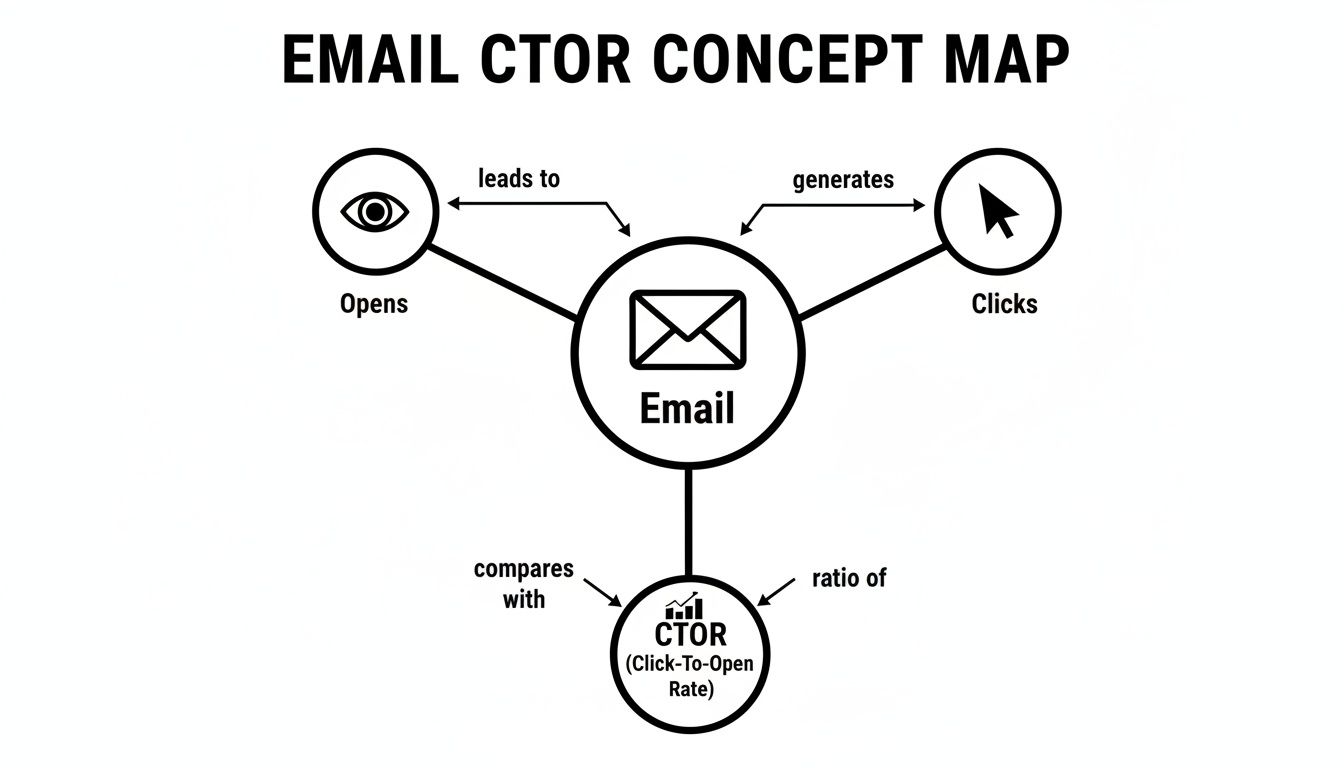
As you can see, CTOR is a focused metric that tells you how well your content resonates with an audience that has already shown interest by opening your email.
Diagnosing Campaign Health With The Right Metric
Knowing the difference isn’t just academic—it’s essential for figuring out what’s working and what’s not in your email strategy. You can’t fix what you can’t accurately measure.
For example, a high open rate paired with a low click through open rate is a classic red flag. This tells you that your subject line wrote a check that your email content couldn’t cash. People were intrigued enough to open it, but once inside, the offer, copy, or design didn’t seal the deal. The takeaway? Your subject lines are probably fine; you need to work on the body of your email.
To really paint a clear picture, let’s look at a few different scenarios for a Shopify store’s email campaigns. The table below shows how these three metrics can reveal very different performance stories.
CTOR vs CTR vs Open Rate A Scenario-Based Comparison
| Campaign Scenario | Open Rate | CTR | CTOR | What It Means |
|---|---|---|---|---|
| A: The Flash Sale Frenzy | 45% | 4.5% | 10% | The subject line (“50% Off Ends Tonight!”) was a huge hit, driving tons of opens. However, the CTOR is low, suggesting the products featured or the email layout didn’t resonate, causing many openers to leave without clicking. |
| B: The Niche New Arrival | 15% | 4.5% | 30% | A very specific subject line (“New: Handcrafted Leather Wallets”) led to fewer opens. But the CTOR is fantastic, showing that the people who did open were highly motivated and loved what they saw. A successful, targeted campaign. |
| C: The Vague Newsletter | 20% | 1% | 5% | The open rate is okay, but both the CTR and CTOR are very low. This indicates a double problem: the subject line wasn’t compelling, and the content inside failed to drive any meaningful action. The entire email needs a rethink. |
Looking at all three metrics together gives you the full narrative of your campaign’s performance, from the moment it hits the inbox to the final click. This clarity is what allows you to stop guessing and start making precise, effective changes that actually move the needle on your sales.
So, What’s a Good Click-Through Open Rate?
If you’re looking for a single magic number that defines a “good” click-through open rate, I have to be honest: it doesn’t exist. The real answer is, “it depends.” What’s great for one brand might be average for another, with things like your industry, audience, and even the type of email you’re sending making a huge difference.
That said, we can definitely set some solid benchmarks to give you a sense of where you stand. For most e-commerce promotional emails, a CTOR between 10% and 15% is a healthy target. Hitting this range is a strong signal that your email’s content and offer are resonating well with the people who actually opened it.
Benchmarks By Email Type
It’s crucial to remember that not all emails are created equal. A weekly newsletter just won’t perform the same way as an urgent abandoned cart reminder, and their CTORs will reflect that difference.
Here’s a quick breakdown:
- Promotional Emails & Newsletters: Aiming for 10-15% is a great goal here. This is your bread-and-butter marketing.
- Transactional Emails: These are the superstars. Things like order confirmations and shipping updates can easily see a 15-25% CTOR. People are actively looking for this information and are primed to click a tracking link or view their order.
- Lifecycle Emails: Welcome series, abandoned cart flows, and other automated emails triggered by a customer’s action should also have high CTORs. They’re timely, personal, and highly relevant.
Don’t Forget the Bigger Picture with CTR
While CTOR is fantastic for measuring how effective your email content is, you still need to keep an eye on your overall click-through rate (CTR). With privacy changes making open rates a bit fuzzy, the standard CTR has become a go-to metric for judging a campaign’s total success from inbox to click.
Across all industries, the average email CTR hovers around 2.44%. Anything over 2.5% is considered pretty good, and if you’re hitting 3.5% or more, you’re doing exceptionally well. For Shopify merchants, this is where the rubber meets the road—turning those valuable clicks into actual sales.
For a wider perspective on engagement, it can be helpful to understand what a What is a Good Click Through Rate looks like on other platforms, too. Ultimately, use these numbers as a guidepost, not a strict rulebook. The most important data is your own, and the best strategy is to keep improving it.
Actionable Tactics To Improve Your CTOR

Knowing your numbers is one thing, but actually moving the needle is where the real revenue is made. A strong click through open rate is never an accident. It’s the result of a smart, deliberate strategy that’s all about delivering value and eliminating friction for your customers.
Let’s break down some proven tactics that get your subscribers to stop scrolling and start clicking. The big idea is simple: the promise you make in your subject line has to be perfectly matched by the content inside. Once they’re in, your only job is to make that next step—the click—obvious, compelling, and effortless.
Sharpen Your Audience Segmentation
Blasting the same email to your entire list is a surefire way to get a dismal CTOR. Think about it: your subscribers have different purchase histories, different interests, and different reasons for being on your list. Segmentation is your key to making every email feel like it was written just for them, which makes clicking feel like the natural next step.
Instead of one giant list, try breaking your audience into smarter, behavior-based groups:
- Past Purchase History: Did someone buy running shoes last month? They’re the perfect audience for an email about new high-performance socks. Sending them an email about casual sandals just doesn’t make sense.
- High-Value Customers: Treat your VIPs like VIPs. Create a segment for your most loyal shoppers and give them early access to a new collection or an exclusive discount. This makes them feel special and encourages them to click and claim their reward.
- Engagement Levels: Got a group that opens everything? Target them with your best offers. For subscribers who’ve gone quiet, a friendly “We Miss You” campaign with a compelling discount can be just the thing to spark their interest again.
Craft Compelling Calls To Action
Your Call-to-Action (CTA) is the single most critical element for getting that click. It needs to pop off the screen, be crystal clear, and push people to act. Vague phrases like “Click Here” or “Learn More” are weak and don’t create any sense of urgency or clarity.
A great CTA tells the user exactly what happens next. Instead of a generic “See Details,” try something like “Shop The 24-Hour Flash Sale.” This creates immediate urgency and connects the action directly to a benefit. Don’t be afraid to A/B test everything—button colors, text, and placement—to find out what your audience responds to.
Reduce Friction With Direct Checkout Links
Every single step a customer takes between your email and the final purchase is a chance for them to get distracted and drop off. If you want to boost both your click through open rate and your conversion rate, you need to make the path to checkout as short as humanly possible.
This is where tools like Checkout Links can be a total game-changer, especially for Shopify merchants. Instead of sending a subscriber to a product page where they still have to add an item to their cart and then find their way to checkout, you can send them straight to a pre-filled cart.
Imagine you’re running a flash sale. With a dynamic checkout link, one click on “Buy Now” can teleport your customer to a checkout page with the product and discount code already applied. That seamless experience shows you respect their time and makes a completed purchase far more likely. This strategy is more relevant than ever, as email engagement continues to climb, with open rates hitting 25.1% and click-through rates reaching 1.5% in 2024. You can dig into more of these trends in this analysis on the state of email marketing.
Optimize For Mobile First
A huge chunk of your audience is reading your emails on their phone, probably while waiting in line for coffee. If your email is a jumbled mess on a small screen, your CTOR is going to take a nosedive.
- Use a single-column layout: This is non-negotiable. It ensures your content stacks neatly and is easy to scroll through.
- Make buttons thumb-friendly: Your CTAs need to be big enough to be easily tapped without a user accidentally clicking on something else.
- Keep copy concise: Break up your text into short, snappy paragraphs. Use bold headlines and bullet points to guide their eyes straight to the important stuff. By putting these tactics to work, you can systematically improve your email’s performance, making sure every open has the best possible shot at turning into a valuable click.
How to Track and Analyze Your CTOR
Improving your click-through open rate isn’t about finding a single magic bullet. It’s a continuous cycle of testing, learning, and refining your approach. The good news is that nearly every modern email service provider (ESP) puts this data right at your fingertips, usually displaying it right next to your open rate and overall click-through rate.
What you’re really looking for are trends, not just one-off wins. A sudden spike in CTOR is fantastic, but a steady, upward climb over several months? That tells you your strategy is really hitting the mark. This long-term perspective helps you separate the lucky shots from the changes—like better segmentation or punchier CTAs—that are genuinely moving the needle.
Connecting CTOR to Your Bottom Line
The real magic happens when you start analyzing your CTOR across different customer segments. This is where you’ll find the most powerful insights. Most ESPs let you filter your reports by audience, so you can see exactly who is engaging the most.
You might find that your VIP customers boast a 30% CTOR, while first-time subscribers are hovering around 10%. That kind of data is pure gold. It tells you exactly where your message is resonating and where you need to focus more attention.
This connection proves the real-world ROI of your email marketing efforts. For a more granular view of what’s working, you can dive deeper into different email link tracking methods to see exactly which links people are clicking.
Once you have a solid handle on CTOR, broadening your understanding of other digital marketing performance metrics will give you a complete picture of your campaign performance. This helps you make smarter, data-driven decisions that don’t just earn clicks, but drive sales and build lasting customer loyalty. By consistently watching and interpreting your CTOR, you turn email marketing from a guessing game into a reliable engine for growth.
A Few Common Questions
As you start digging into your email metrics, a few questions always seem to pop up. Let’s clear up some of the common sticking points around the click through open rate and how it fits into your overall strategy.
How Often Should I Check My Click Through Open Rate?
You should be looking at your click through open rate after every single campaign goes out. Think of it as an instant report card—it tells you right away if the content and offer resonated with the people who opened it.
But for the bigger picture, you’ll want to zoom out. Analyzing your CTOR trends monthly and quarterly is where the real strategic gold is. This helps you see patterns, understand if your optimizations are actually working over time, and get a true sense of your email program’s health beyond the results of just one send.
Can A High Open Rate With A Low CTOR Still Be A Success?
Honestly, it’s pretty rare. This kind of result usually signals a major disconnect. A high open rate is great—it means your subject line did its job and got people in the door. But the low CTOR is a warning sign that the content inside didn’t live up to the hype.
What Is The Fastest Way To Improve My CTOR?
If you’re looking for the quickest win, focus on two things: your Call-to-Action (CTA) and making the customer’s journey as frictionless as possible.
First, your CTA needs to be obvious and compelling. A big, bold button with urgent, action-focused text like “Shop The Sale Now” will always outperform a timid little hyperlink that says “Learn More.”
Second, shorten the path from the click to the checkout. Every extra step is a chance for a customer to get distracted or change their mind. Using tools that send shoppers directly to a specific product page or, even better, a pre-filled cart can give you an immediate lift in your click through open rate and, most importantly, your sales.
Ready to slash that friction and watch your CTOR climb? With a tool like Checkout Links, you can build direct-to-checkout experiences that turn a simple email click into an instant sale. Start creating powerful checkout links today and see just how much of a difference a seamless journey can make.