If you’re running a Shopify store, you know the thrill of getting a new customer. But what happens after that first sale? If the answer is “nothing,” you’re facing a hidden profit killer: customer churn.
Even a 5% increase in customer retention can boost your profits by a massive 25% to 95%. It’s time to shift your focus from chasing new customers to keeping the ones you already have.
The Hidden Profit Killer Draining Your Shopify Store
Let’s get real about churn. It’s the silent force that quietly eats away at your Shopify store’s profitability. When a customer buys once and never comes back, you haven’t just lost a single sale—you’ve lost all the potential future revenue that person could have brought you.
This isn’t some minor leak; it’s a huge drain on your bottom line. Think about your Customer Lifetime Value (CLV), which is the total revenue you can reasonably expect from a single customer. Every time a customer churns, their CLV is cut short, directly damaging your store’s long-term financial health. Reducing churn isn’t just a nice idea; it’s absolutely critical for sustainable growth.
Why Retention Is Your Biggest Growth Lever
The e-commerce world is tough, and the numbers don’t lie. The average customer churn rate can hit a staggering 77%. That means most stores are losing the vast majority of their customers after just one purchase. In a market where 85% of global consumers now shop online, Shopify merchants can’t afford to ignore this. If you want to dive deeper into the numbers, you can find more insights about digital commerce statistics on Cimulate.ai.
This is where the financial argument for retention becomes impossible to ignore. It costs anywhere from five to 25 times more to acquire a new customer than it does to keep an existing one.
Let’s break down what that really means for your budget.
The Financial Impact of Churn vs Retention
A quick look at the costs and benefits shows a clear winner when it comes to prioritizing your marketing spend.
| Metric | Acquiring a New Customer | Retaining an Existing Customer |
|---|---|---|
| Cost | 5x to 25x higher | Significantly lower |
| Conversion Rate | 5% to 20% | 60% to 70% |
| Profitability | Lower margin per sale | Higher margin, increased CLV |
| Marketing Focus | Top-of-funnel awareness | Building relationships & loyalty |
As you can see, investing in the customers you’ve already won is not only cheaper but far more effective.
Introducing a Powerful Tool to Fight Churn
Fighting back against churn requires more than good intentions; you need the right tools in your arsenal. This is where platforms like Checkout Links become incredibly valuable for Shopify merchants. They give you a direct way to create personalized offers and smooth, frictionless experiences that give customers a real reason to come back.
For example, you can quickly generate unique links with specific discounts tailored to different customer segments—like a special offer for first-time buyers who haven’t returned in 60 days.
This is a core tactic in any modern retention strategy. Throughout this guide, we’ll walk through practical, actionable strategies that use tools like this to win back customers and put a serious dent in your churn rate.
Becoming a Churn Detective in Your Shopify Store
Before you can fix a leaky bucket, you have to find the holes. The same goes for customer churn. Guessing why customers are leaving is a fast track to wasted effort. To make a real difference, you have to put on your detective hat and dig into your data to figure out not just how many customers are leaving, but why.
Your investigation starts with a simple calculation. While Shopify doesn’t have a big red “churn rate” button, you can get a solid estimate using the returning customer rate in your Shopify Analytics. If your returning customer rate is 25%, you can think of your churn rate as the other 75%. This number is your starting point—your first clue.
Digging Deeper into the Numbers
A single number gives you a baseline, but the real story is in the details. You need context. E-commerce churn averages a staggering 77% annually, and in competitive niches like fashion, it can easily hit 70-80%. Think about that: a store bringing in 3,000 new customers might only see 700 of them come back within six months. As this deep-dive into e-commerce churn on LoyaltyLion.com explains, targeted strategies can completely flip this, pushing retention toward 40%.
To get this kind of clarity for your own business, you have to move beyond store-wide averages and start segmenting. This is where cohort analysis becomes your best friend. A cohort is just a group of customers who share a common trait, most often when they made their first purchase.
Analyzing cohorts helps you answer the really important questions:
- Do customers who bought during a Black Friday sale disappear faster than those who bought a new product on launch day?
- Is churn higher for customers who came in on that big “20% off your first order” discount?
- Do people who buy Product X stick around longer than people who buy Product Y? Shopify’s reports let you filter customers by the date of their first order, what they bought, and which marketing channel brought them in. Use these filters to build and compare different cohorts. This is how you spot the behavioral patterns that a single, blended churn rate will always miss.
Uncovering the Qualitative ‘Why’
Your analytics tell you what is happening. Your customers are the only ones who can tell you why. Numbers can’t show you the frustration of a confusing checkout or the disappointment of a lackluster unboxing experience. For that, you need to actually talk to people.
Here are a few straightforward ways to gather that crucial feedback:
- Post-Purchase Surveys: Add a simple, one-question survey right after checkout. Ask something direct like, “What almost stopped you from buying today?” You’ll be amazed at the friction points this can uncover.
- Churn Surveys: For subscription brands, this is a must-do. When someone cancels, find out why. For everyone else, you can email a survey to customers who haven’t purchased in, say, 90 or 180 days. A simple “We miss you, what could we have done better?” can work wonders.
- Customer Interviews: Nothing beats a real conversation. Reach out to a handful of your best customers and a few one-and-done buyers. A 15-minute chat can provide more actionable insight than weeks of staring at spreadsheets. Just offer a small gift card for their time.
Learning how to spot the root causes of churn is a skill. The more you practice, the better you get at it. Digging into resources on how to reduce customer churn can help you move from simply reacting to problems to proactively building a store that customers want to return to. Now, let’s talk about putting these insights into action.
Personalized Retention Tactics That Win Customers Back
Once you’ve figured out why customers are leaving, you can stop playing defense and start going on offense. This is where you get to use smart, personal tactics that don’t just plug the leaks but actually win people back and build real loyalty. Let’s be honest, generic, one-size-fits-all promotions are dead. Personalization is what makes customers feel seen and valued.
With a tool like Checkout Links, you can put these ideas into action right away. The whole point is to make it incredibly easy—and tempting—for a customer to make that next purchase.
Launch a Proactive Welcome Series
That period right after a customer’s first purchase? That’s your golden window. They’ve already put their trust in you. A well-timed, relevant follow-up can make the difference between a one-time buyer and a lifelong fan. Don’t wait for them to forget about you.
A proactive welcome series is more than just a “thanks for your order” email. It’s your chance to guide them to their next favorite product.
- Scenario: A customer just bought your best-selling face serum.
- Tactic: Three days after their order is delivered, send them an email with a personalized Checkout Link for a moisturizer that pairs perfectly with it.
- The Offer: That link can pre-apply a 15% discount and have the moisturizer already waiting in their cart. All they have to do is click once to buy. This isn’t a hard sell; it’s a helpful suggestion. It works because it’s timely, relevant, and ridiculously simple for the customer to act on.
Re-Engage At-Risk Customer Segments
Using the customer segments we talked about earlier, you can spot customers who are starting to drift away. A classic example is the “one-time buyer who hasn’t purchased in 90 days” group. These folks are on the verge of churning for good, but a well-timed, exclusive offer can pull them right back.
For instance, a coffee subscription service could flag customers who made a single purchase three months ago. They could then send a “We’ve missed you!” email with a compelling offer to come back.
This process—finding and segmenting these at-risk groups—is the bedrock of any successful re-engagement campaign.
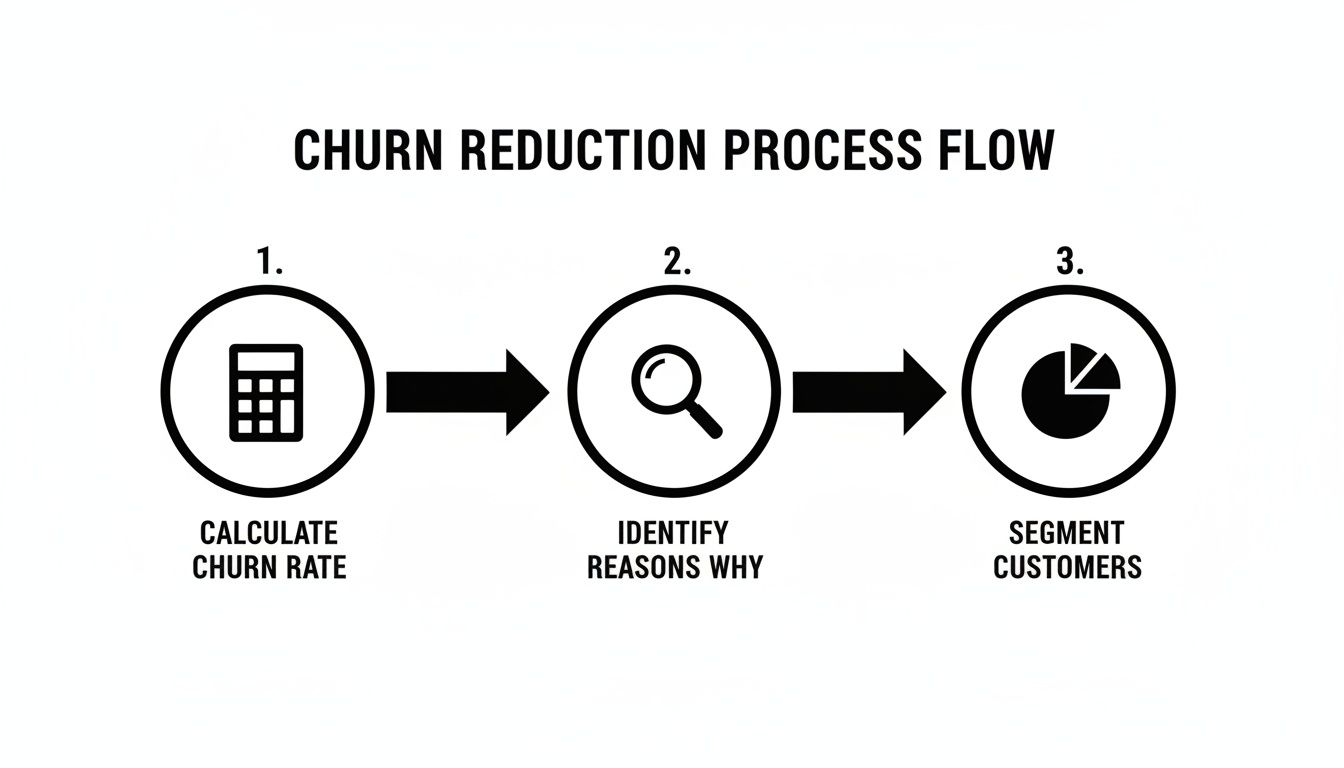
When you calculate your churn rate, pinpoint the reasons, and segment your customers, you’re building a data-driven foundation for your outreach. It ensures your offers land with the right people at just the right moment. If you want to dive deeper into grouping your audience effectively, you can explore the fundamentals of what segmentation is and why it matters.
Supercharge Your Cart Recovery Efforts
Abandoned carts are a constant headache, but they also represent highly motivated shoppers. Standard cart recovery emails are fine, but you can make them so much more powerful by removing every ounce of friction. Instead of just a reminder, give them a direct, one-click path to finish their purchase from wherever they are.
Imagine sending a friendly SMS or a quick social media DM that says, “Hey [Name], looks like you left something behind! Here’s a direct link to finish your order, with free shipping on us.” The link whisks them straight to a pre-filled checkout. No need to go back to the site, find their cart, and re-enter their info. This frictionless experience can drastically boost conversions and reduce churn rate tied to checkout frustration.
Create Exclusive Bundles and Offers
Personalization isn’t just about discounts; it’s about creating value that feels exclusive to that specific customer. You can use Checkout Links to craft special product bundles or promotions that aren’t available to the general public.
Here are a few ideas I’ve seen work wonders:
- The “Complete Your Routine” Bundle: For a beauty brand, if someone buys a cleanser, you can follow up with a link to a discounted bundle that includes the matching toner and serum.
- The “VIP Early Access” Offer: Reward your top customers with a passcode-protected link to shop a new collection 24 hours before anyone else. This creates a powerful sense of exclusivity and reinforces their VIP status.
- The “Refill & Save” Link: For consumables like coffee or supplements, send a timely reminder with a Checkout Link that has their last order pre-loaded in the cart, maybe with a small discount for being a loyal re-orderer. These tactics prove you’re paying attention to their needs and purchase history, which turns a simple transaction into a personalized shopping experience. To keep that momentum going, you could even explore things like loyalty program gamification to add a fun, competitive layer to your retention strategy. When your marketing feels more like a service, you build the kind of brand loyalty that turns customers into advocates.
Use A/B Testing to Perfect Your Retention Offers
Stop guessing what your customers want. Making assumptions about which offers will actually keep them around is a fast track to wasting your marketing budget. The best way to figure out what really works is to let your customers tell you themselves through methodical A/B testing.
This isn’t some complex process reserved for data scientists. It’s a surprisingly straightforward tool for any Shopify merchant, and you don’t need to write a single line of code. With a tool like Checkout Links, you can easily set up experiments to see which offers are the most compelling. The concept is simple: you create two different offers, show them to similar groups of customers, and see which one performs better.
Start with a Clear Hypothesis
Every good test starts with a question—an educated guess about what will make your customers tick. This hypothesis needs to be clear, specific, and measurable.
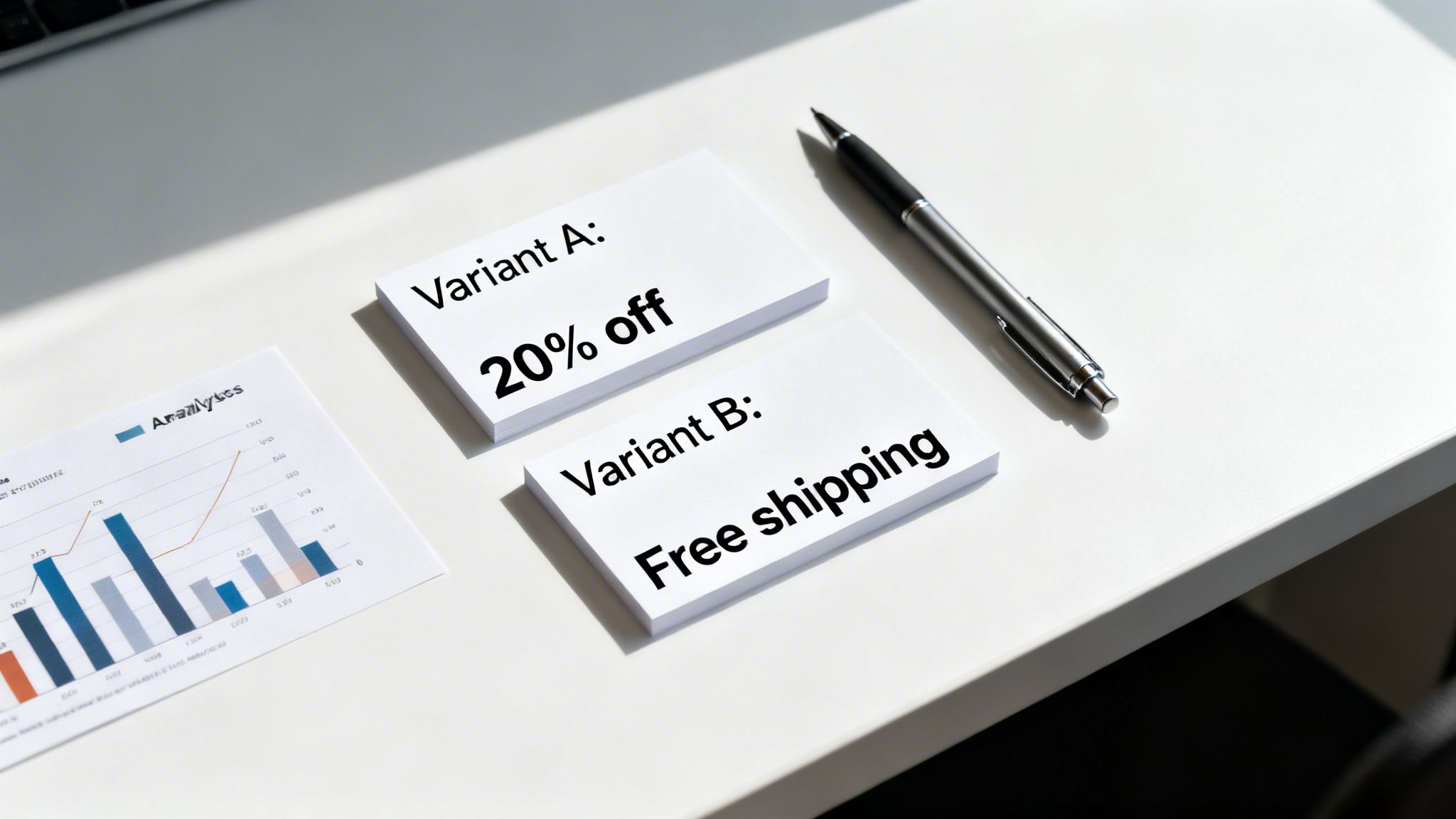
Instead of a vague goal like “win back more customers,” think in terms of a direct comparison. For instance, a solid hypothesis might be: “For customers who haven’t purchased in 90 days, an offer of free shipping will drive more sales than a 20% discount.”
This immediately gives your test a clear purpose and a defined finish line. You’ll know exactly what success looks like.
Setting Up Your A/B Test with Checkout Links
Once you have your hypothesis, building the test is next. Using Checkout Links, this takes just a couple of minutes. You’ll create two distinct, shareable links that represent the two sides of your experiment.
- Create Link A (Your Control): First, generate a Checkout Link for the target product and apply your first offer. In our example, this would be the 20% discount.
- Create Link B (Your Variant): Now, duplicate that link. This time, apply your second offer. This new link will add the same product to the cart but will offer free shipping instead. That’s it. You now have two unique URLs, each leading to a pre-filled cart with a different incentive. The experience is seamless for the customer, but you’re gathering invaluable data on the backend.
Distribute the Test and Analyze the Results
With your links ready, it’s time to get them in front of your customers. For the test to be valid, you have to send each offer to a similar group of people. The easiest way to manage this is with an email marketing platform that has built-in A/B testing, like Klaviyo, Mailchimp, or Omnisend.
You’ll split your target segment—in this case, “customers inactive for 90+ days”—into two random groups. Group A gets the email with Link A (20% off), and Group B gets the email with Link B (free shipping).
After the campaign runs, check your analytics. Compare the conversion rates for each link. Did the 20% discount win, or did free shipping prove to be the stronger motivator? The data gives you a clear winner, removing all the guesswork from your strategy.
Comparing two discount links against each other shows which offer actually brings people back. This aligns with what we know about e-commerce friction—even small hurdles can cause abandonment, a crucial insight as you work to grow your brand. If you’re interested in more data like this, you can discover other fascinating e-commerce statistics on SellersCommerce.com.
To get you started, here are a few practical test ideas you can run using Checkout Links.
Sample A/B Test Ideas for Retention
| Test Variable | Option A | Option B | Target Segment |
|---|---|---|---|
| Discount Type | 15% Off Entire Order | $10 Off Entire Order | First-Time Customers |
| Incentive | Free Shipping | Free Gift with Purchase | Lapsed VIP Customers |
| Urgency | “Offer expires in 48 hours” | “Offer expires in 7 days” | Abandoned Cart Segment |
| Product Offer | Buy One, Get One 50% Off | Buy Two, Get One Free | Repeat Purchasers |
These are just starting points. The real magic happens when you start testing ideas specific to your products and customer base.
By continuously testing and refining your offers, you’ll develop a deep, practical understanding of what your customers truly value. This allows you to perfect your retention strategy and effectively reduce churn rate for good.
How Do You Know If Your Churn Reduction Efforts Are Actually Working?
It’s one thing to launch new retention strategies, but it’s another thing entirely to know if they’re actually making a difference. You can’t just throw tactics at the wall and hope for the best. To genuinely reduce churn rate, you have to measure your efforts with a sharp eye. This is how you turn guesswork into a repeatable, scalable growth engine for your store.
https://www.youtube.com/embed/ATUztd4IemI
Think of it as creating a feedback loop. You track performance, see what’s resonating with your customers, and then you pour more resources into those winning strategies. This data-first mindset is the real secret to building a sustainable business where your customers don’t just buy once—they come back again and again. It’s all about proving that your hard work is paying off with real, measurable results.
Nailing Down Your Core Retention KPIs
Key Performance Indicators (KPIs) are the pulse of your business. If you’re watching the right ones, they’ll tell you whether your retention efforts are hitting the mark or if it’s time to pivot. For any Shopify merchant serious about growth, a few metrics are simply non-negotiable.
Your retention dashboard should revolve around these core KPIs:
- Customer Churn Rate: This is your most direct measure of churn. It’s the percentage of customers who fail to make another purchase within a specific timeframe. Your main objective is to see this number consistently trend downward.
- Repeat Customer Rate: Essentially the flip side of churn, this shows what percentage of your customers return for a second purchase (or third, or fourth). A rising repeat customer rate is a crystal-clear sign your retention tactics are working.
- Customer Lifetime Value (CLV): This is the total profit you can expect to earn from a single customer over their entire relationship with your brand. As you successfully reduce churn, your CLV should steadily increase, proving you’re building a healthier, more profitable customer base.
- Purchase Frequency: This metric tells you how often the average customer buys from you. If your re-engagement campaigns are hitting home, you’ll see customers returning to your store more often. Tracking these metrics in tandem gives you a complete view of your customer retention health. They don’t exist in a vacuum; they work together to tell a story about whether your customers are staying, and just how valuable that loyalty has become. If you want to dive deeper, you can learn more about the essential customer retention metrics every e-commerce business should track.
How to Actually Track Your Retention Metrics
So, where do you find all this data? The good news is you probably don’t need a complex or expensive analytics suite. You can get most of what you need by piecing together the tools you’re already using.
Your main data sources will likely be Shopify’s built-in analytics and the dashboard of any retention tools you’re using, like Checkout Links. Shopify’s reports give you foundational data on your returning customer rate and CLV, which you can find right in your admin under Analytics > Reports.
But the real insight comes when you start connecting that high-level data to your specific campaigns. For example, let’s say you run an A/B test with two different Checkout Links to re-engage customers who haven’t bought in 90 days. Your link-specific analytics will tell you which offer got more clicks and conversions. Then, you can look at your Shopify reports to see if that campaign corresponded with an overall dip in your monthly churn rate.
Turning Data Into Actionable Insights
Collecting data is only half the battle. The real value is unlocked when you can interpret what the numbers are telling you and decide what to do next. Your KPIs rarely move in isolation; they influence one another and paint a story about your business.
Keep an eye out for these key patterns in your data:
- Falling Churn Rate & Rising CLV: This is the dream scenario. It means you’re not only keeping more customers, but the ones you keep are becoming more valuable over time. It’s the clearest sign of a healthy, growing brand.
- Increased Repeat Customer Rate: When this number ticks up right after you launch a new welcome series or a targeted win-back campaign, you have direct proof that your tactic is working. It’s the validation you need to keep that program running or even expand it.
- A Spike in Purchase Frequency: Did you introduce a “time to reorder” campaign for your consumable products using personalized Checkout Links? If you see purchase frequency climb for that specific customer segment, you know your timing and your offer were right on the money. Don’t get discouraged if you see a metric dip or flatten out for a while. The goal isn’t immediate perfection; it’s consistent progress. Use the data to ask smarter questions. If a campaign didn’t move the needle, was the discount not compelling enough? Was the audience segment too broad? Every result, good or bad, is a lesson that makes your next attempt even better.
Answering Your Top Questions About Shopify Churn
As you start digging into your retention strategy, you’re going to have questions. That’s a good thing—it means you’re really thinking about how to reduce churn rate and build a more resilient business. Let’s walk through some of the most common questions I hear from Shopify merchants and give you some straight answers to help you move forward.
How Often Should I Actually Calculate My Churn Rate?
Tracking churn isn’t a one-off task; it’s a rhythm you need to establish for your business. For most Shopify stores, I’ve found a two-part approach works best.
First, calculate your churn rate monthly. This gives you an active, almost real-time pulse on your business. It’s the best way to spot any sudden spikes or dips, so you can figure out what happened and react quickly.
Then, you’ll want to do a more thorough, big-picture analysis quarterly. This is your chance to zoom out, identify broader trends, and plan your long-term strategy. For instance, a monthly check might just show a bad week. But a quarterly review could reveal that your churn consistently climbs in the third month after a major holiday sale—now that’s a pattern you can get ahead of next year.
What’s a Good Churn Rate for a Shopify Store?
This is the question everyone asks, and the most honest answer is: it really depends. There’s no single magic number that defines “good.”
A subscription box business, for example, might aim for a monthly churn rate below 5% to stay healthy. On the other hand, a fast-fashion brand that lives and dies by fleeting trends could see churn rates closer to 20-30% and still be thriving. It’s just the nature of their market.
Instead of getting hung up on industry benchmarks, focus on continuous improvement. Is your churn rate this month lower than it was last month? Is your rate this quarter better than the same quarter last year? That consistent downward trend is the truest sign of a successful retention strategy.
Can I Really Reduce Churn Without Constantly Offering Discounts?
Yes, and you absolutely should. Relying too heavily on discounts is a dangerous game. It can train your customers to wait for a sale, which just eats away at your profit margins over time. Building real, lasting loyalty comes from the value you provide, not just the price you offer.
Here are a few powerful non-monetary tactics that work wonders:
- Offer Exclusive Access: You can use a tool like Checkout Links to generate passcode-protected pages for new product drops. Send that code only to your most loyal customers, giving them a head start before the collection goes live to the public. It makes them feel like true VIPs.
- Provide Valuable Content: Create exclusive content like expert styling guides, how-to video tutorials, or a behind-the-scenes look at how your products are made. Make this content accessible only to repeat customers to reward them for sticking with you.
- Deliver Exceptional Support: Never underestimate the power of great customer service. A fast, empathetic, and genuinely helpful interaction can be far more memorable than a 10% discount. When you solve a customer’s problem with real care, you build an emotional connection that discounts can’t buy. These strategies shift the focus from a simple transaction to a genuine relationship. That connection is what truly makes customers feel valued and is the most effective way to ensure they keep coming back.
Ready to put these ideas into practice? Checkout Links gives you the power to create personalized offers, exclusive access links, and seamless shopping experiences in just a few minutes. Stop guessing what might work and start building a retention strategy that delivers real, measurable results. Get Checkout Links and start reducing your churn rate today!