At its core, demographic segmentation is all about breaking down your large, diverse audience into smaller, more focused groups. Instead of shouting into the void, you’re organizing your customers based on shared, measurable traits like age, gender, income, and education so you can speak to them more directly.
Understanding Demographic Segmentation in Marketing

Imagine you have a massive, jumbled pile of playing cards. Trying to play a game would be chaos. The first thing you’d do is sort them by suit—hearts, diamonds, clubs, and spades. Suddenly, you have order and can play any game you want, efficiently. That’s exactly what demographic segmentation does for your marketing.
This strategy helps you move past one-size-fits-all messaging. It’s the difference between seeing a faceless crowd and recognizing distinct groups of real people with their own needs, priorities, and life experiences. When you understand these differences, you can stop treating everyone the same and start building real connections.
Why Demographics Are a Core Marketing Tool
Demographic information is often the easiest and most reliable data to get your hands on. It provides a clear, factual answer to the most fundamental question in marketing: “Who are my customers?”
In the real world, this insight is pure gold. A Shopify store, for instance, could use a tool like Checkout Links to create and send a special discount link directly to high-income urban millennials—a group expected to make up 27% of global online shoppers by 2026. This isn’t just about boosting sales; it’s about making your marketing spend work smarter, not harder.
Demographics are a fantastic starting point, but they are just one of several types of market segmentation you can use to get a complete picture of your audience.
Here’s a quick breakdown of the core demographic variables and why each one is so valuable for an online business.
Core Demographic Variables at a Glance
This table covers the most common demographic data points marketers use and explains why they’re so crucial for any e-commerce brand.
| Variable | Description | Why It Matters for E-commerce |
|---|---|---|
| Age | A customer’s age or generation (e.g., Gen Z, Millennial, Gen X). | Influences communication style, product preferences, and platform usage. |
| Gender | A customer’s gender identity. | Affects product design, marketing imagery, and messaging tone. |
| Income | A customer’s household or personal income level. | Determines purchasing power, price sensitivity, and affinity for luxury vs. value. |
| Education | A customer’s highest level of education completed. | Can impact the complexity of messaging and the perceived value of information. |
Getting a handle on these four variables gives you a solid foundation for creating marketing that actually resonates with people.
The Six Key Lenses for Viewing Your Customers
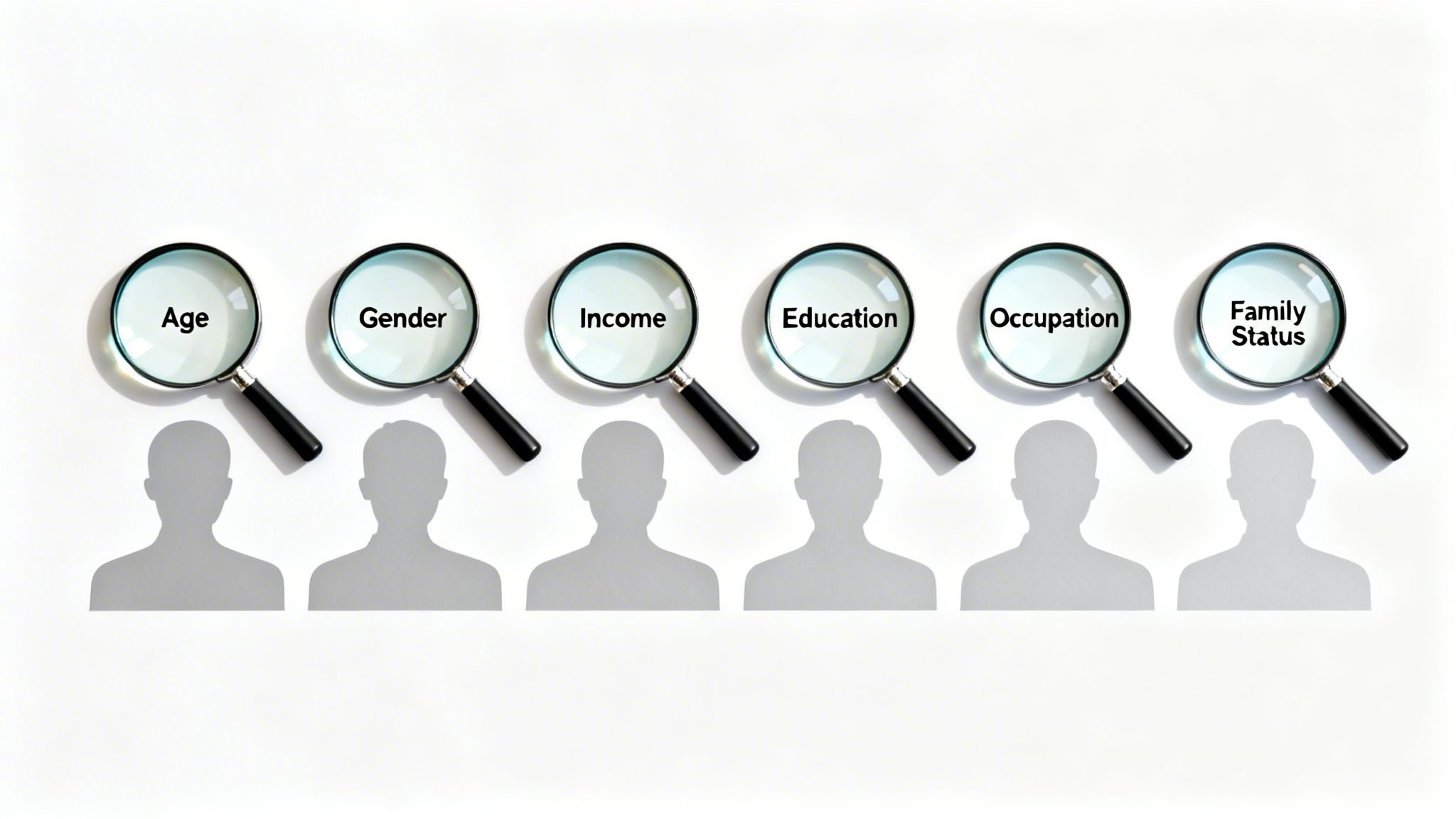
It’s one thing to grasp the basic idea of demographic segmentation, but putting it into practice is where the magic really happens. To do it right, you need to look at your audience through a few different lenses. Each one brings a new layer of detail into focus, helping you turn a blurry, one-size-fits-all market view into a collection of sharp, well-defined customer portraits.
Let’s dig into the six main variables that are the foundation of this strategy. Think of them as different filters you can apply to see who your customer truly is and what they’re likely looking for.
1. Age and Generational Cohort
Age is probably the most common starting point, and for good reason. Our needs and wants change dramatically as we move through life. What a teenager cares about is a world away from a retiree’s priorities, and that simple fact impacts everything from the products they buy to the apps on their phones.
A skincare company, for example, isn’t going to run the same campaign for Gen Z that it does for Gen X. They’ll target the younger crowd with acne solutions and the older one with anti-aging serums. Beyond just age, generational cohorts like Gen Z, Millennials, Gen X, and Baby Boomers share unique cultural reference points and ways of communicating, which is gold when you’re trying to create ads that actually connect.
2. Gender
Segmenting by gender helps brands speak to different preferences, whether it’s through product features, color palettes, or marketing imagery. While we’re seeing a wonderful and long-overdue move toward more fluid and inclusive approaches, gender is still a key differentiator in industries like apparel, cosmetics, and personal care.
A clothing retailer might focus on rugged, performance-based features for its men’s line while showcasing comfort and versatile styles in its women’s collection. The key is to be thoughtful. Smart brands avoid tired stereotypes and are quick to recognize the growing market for gender-neutral products.
3. Income Level
How much money someone makes directly impacts their spending habits and how sensitive they are to price. By sorting your audience into income brackets—low, middle, or high—you can position your products and price them in a way that makes sense.
Take a car manufacturer. They’ll aim their slick ads for luxury models at high-income households, while their more affordable options will be marketed to first-time buyers and families watching their budget.
4. Education and Occupation
These two data points are often intertwined and can give you some surprisingly deep insights into a customer’s lifestyle, hobbies, and even their level of technical expertise. A person’s job can tell you a lot about their day-to-day challenges, while their education might influence how they absorb complex information.
- Education Level: This helps you set the right tone. A brand selling sophisticated financial software can use more technical language when speaking to an audience with advanced degrees.
- Occupation: This provides powerful context for a person’s needs. If you’re selling ergonomic office chairs, you’re naturally going to target remote workers and people in corporate roles, not construction workers.
5. Family and Marital Status
A person’s home life—whether they’re single, married with young kids, or an empty-nester—shapes their buying habits in huge ways. This is an incredibly powerful variable, especially for businesses in the home goods, travel, and food industries.
A meal-kit delivery service might create quick, single-serving meals for young professionals living alone, while at the same time promoting larger, family-sized boxes to busy parents. Understanding someone’s family status allows you to create highly relevant offers that solve a real, specific problem in their household.
Each of these lenses gives you a clearer picture, helping you understand your audience not as a faceless crowd, but as a diverse collection of unique individuals.
How Winning Brands Use Demographic Segmentation
It’s one thing to talk about demographic segmentation in theory, but seeing it in action is where the magic really happens. The best brands don’t just gather data for the sake of it—they use it as a compass to create marketing that feels genuinely personal and relevant. Let’s look at a few examples from different industries to see how knowing who your customer is can make all the difference.
The beauty industry is a fantastic place to start. Brands here are absolute pros at segmenting by gender and age. An incredible 95% of the industry’s marketing budget is aimed squarely at women, but the strategy gets far more granular than that.
Take anti-aging skincare, for example. Lines developed specifically for women over 40 are a direct response to a clear demographic need. This group isn’t just a small niche; they’re responsible for a massive 28% of global beauty spending. Brands that speak directly to their concerns are winning big.
From Family Dinners to Luxury Cars
This isn’t a new concept, either. One of the most classic success stories comes from the restaurant world. Back in the early 2000s, Olive Garden launched campaigns that zeroed in on families with children. They positioned their restaurants as the perfect place for parents to connect with their kids over a meal. The results were astounding—a 22% sales increase in those family-focused markets by 2005. You can discover more insights about this and other powerful segmentation tactics.
We see the same playbook used across the automotive industry, where income and family size dictate entirely different marketing messages:
- Luxury Brands: Think Mercedes-Benz. Their ads target high-income earners by highlighting performance, status, and sophisticated technology.
- Family-Focused Brands: Contrast that with Honda or Toyota. They focus their marketing on safety, reliability, and cargo space to win over middle-income families.
This is the key. Moving from a generic, one-size-fits-all message to something that feels specific and personal is how you turn a casual browser into a loyal customer. Whether it’s a skin cream for a specific age-related concern or a car designed for a growing family, demographic insights build the foundation for marketing that connects.
The most successful brands have proven time and again that knowing your audience isn’t just a marketing tactic. It’s a core business strategy that drives engagement, loyalty, and serious growth—and these principles work just as well for a modern Shopify store as they did for a restaurant chain two decades ago.
Putting Demographic Segmentation to Work on Your Store
Knowing what demographic segmentation is is one thing; putting it into practice is where the real magic happens. This is where we move from theory to action, turning those demographic insights into real-world results for your Shopify store. The top-performing brands are masters at this, using demographic data to build targeted campaigns and find effective strategies to increase ecommerce sales.
So, let’s walk through exactly how you can start collecting and using this data in a way that’s both smart and respectful of your customers.
How to Collect Demographic Data
You don’t need a huge budget or a dedicated data science team to get started. In fact, you probably already have access to a wealth of demographic information through the tools you use every day.
- Shopify Analytics: Right inside your Shopify dashboard is a trove of anonymous, aggregated customer data. You can see where your customers are located, which gives you a solid geographic profile right out of the box.
- Ad Platform Insights: If you run ads on Meta or Google, you have access to powerful analytics. Their dashboards provide rich, anonymous reports on who sees your ads and visits your site, breaking it down by age, gender, and location.
- Customer Surveys: Never underestimate the power of simply asking. A quick post-purchase survey, created with a tool like Typeform or even a simple Google Form, can give you incredible insights. Offer a small discount on a future purchase as a thank you for their time.
- Newsletter Sign-Ups: Your email sign-up form is another great opportunity. You can add optional fields to learn more about your subscribers. For example, asking for a birthday allows you to segment by age and send out personalized birthday offers down the line. The image below gives a high-level look at how different industries put segmentation into play.
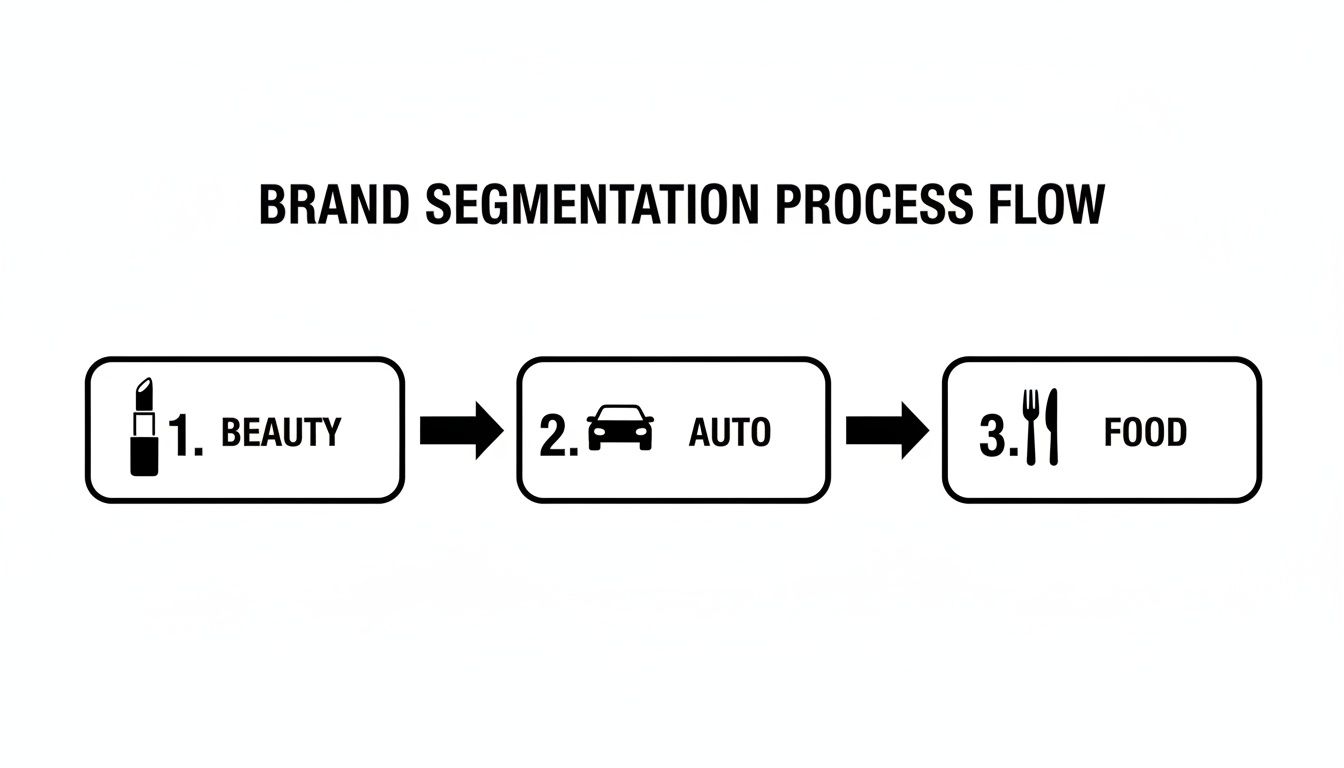
This flow shows how industries as different as beauty, automotive, and food use segmentation to speak more directly to their customers. Each path represents a unique way of grouping people based on their specific traits and what they need from a product.
Turning Data Into Actionable Campaigns
Once you’ve gathered this information, it’s time to put it to work. The whole point is to create marketing that feels more personal and relevant to each customer group. This is where modern tools built for Shopify really shine.
For instance, using a tool like Checkout Links lets you create highly specific offers without touching a single line of code. Let’s say you’ve found a high-income segment that loves your premium product line. You could create a passcode-protected checkout link with an exclusive discount on that collection and send it directly to them.
Using a tool like this lets you translate what you know about your customers directly into sales. If you want to dive deeper, you can find more examples of customer segmentation in our other guide.
Here are a few more practical ideas you can try today:
- Targeted Social Ads: Use the age and location data from your analytics to run a Meta ad campaign. You could promote a new product line specifically to 25- to 34-year-olds living in major cities where you see a lot of sales.
- Segmented Email Flows: If you have subscribers who identified themselves as students, create a separate email welcome series just for them. You can offer a student discount and point them toward your most budget-friendly products.
- Event-Specific QR Codes: Are you hosting a pop-up shop at a local university? Create a branded QR code that sends shoppers to a special checkout page with a discount. This is a brilliant way to target a younger, hyper-local demographic.
Measuring Your Success and Avoiding Common Mistakes
https://www.youtube.com/embed/i-HNJZeOOMY
So, you’ve built your demographic segments. That’s a huge step, but the real work is just beginning. A strategy is only as good as the results it delivers, and now you need to figure out if your efforts are actually moving the needle. This is where you separate a good plan from a profitable one.
The proof is often right there in the data. Just look at email marketing. We know that segmented campaigns can pull in 3x more revenue than generic, one-size-fits-all emails. They also get a 15% bump in open rates. Numbers like these don’t just feel good—they’re concrete evidence that you’re truly connecting with your audience.
Key Metrics for Measuring Success
To see what’s resonating, you need to track a few key performance indicators (KPIs) for each demographic group. Think of it as a report card for your strategy. It tells you what’s working, what isn’t, and where you need to adjust your aim.
- Conversion Rate per Segment: Are your Gen Z shoppers converting more often from your mobile-first ads? If so, you know the message and the medium are a perfect match.
- Average Order Value (AOV): Did your campaign targeting high-income professionals lead to bigger carts? A higher AOV from that group shows your product positioning is spot on.
- Customer Lifetime Value (CLV): This is the ultimate goal. When you see a high CLV from a specific demographic, it means you’ve done more than just make a sale—you’ve built genuine, long-term loyalty. A/B testing is your secret weapon here. Pit different offers, headlines, or images against each other within the same demographic to see what clicks. For example, you could use a tool like Checkout Links to generate two different discount codes for your “college student” segment and track which one brings in more sales.
Common Mistakes to Avoid
Even with the best data and intentions, it’s surprisingly easy to get things wrong. Knowing the common traps is the first step to sidestepping them entirely.
This leads directly to the most common pitfall: relying on stereotypes. Thinking all older customers are tech-illiterate is a classic blunder. The reality is that internet use among people over 65 shot up from 52% in 2011 to 83% in 2019. Never assume.
Here are a few other missteps to watch out for:
- Creating Segments That Are Too Small: A niche segment of “left-handed rock-climbing dads who live in Idaho” might be interesting, but if there are only 50 of them, it’s not a profitable audience. Your segments need to be substantial enough to be worth the effort.
- Ignoring Other Data Types: Demographics are powerful, but they’re not the whole story. The best strategies combine demographics with behavioral data (what they browse and buy) and psychographic data (their values and interests) for a complete 3D view of the customer.
- Forgetting to Update Your Segments: Life happens. People age, get new jobs, have families, and move. The segments you created last year might be out of date. You have to refresh your data regularly to keep your marketing sharp and relevant.
Common Questions About Demographic Segmentation
Getting started with demographic segmentation always brings up a few good questions. It’s smart to think through the ethics and practical details before you dive in. Let’s tackle some of the most common ones so you can move forward with confidence.
Isn’t Demographic Segmentation Outdated or Stereotypical?
That’s a fair question, and the honest answer is: it absolutely can be, if you do it wrong. Thinking of demographics as a way to slap a lazy label on a group of people is a recipe for failure.
Instead, think of demographics as the first, foundational layer of your targeting—a starting point, not the final word. The real magic happens when you start layering it with other types of data.
Knowing you have a 30-year-old male customer is interesting. But knowing he’s a 30-year-old male who has bought high-end running shoes from you before (behavioral) and lives in a dense urban area (geographic) is powerful. Now you can send him a genuinely relevant offer for city running gear. You’ve moved from a broad generalization to a sharp, personal message.
How Do I Get Customer Data Without Being Intrusive?
Collecting customer data ethically is a must, and thankfully, it’s not as hard as it sounds. The key is to be transparent and offer a fair trade.
You already have a ton of anonymous, aggregated data at your fingertips. Your Shopify Analytics, plus reports from platforms like Meta and Google, give you a great overview without ever touching personal info.
For more direct data, just ask—but make it worth their while.
- Optional Form Fields: When a customer signs up for your email list or creates an account, add optional fields like their birthday. A promise of a special birthday discount makes it a clear win-win.
- Post-Purchase Surveys: After a successful checkout is the perfect time to ask a few quick questions. Offering 10% off their next order is a fantastic incentive to get them to share a bit more about themselves. Just be straight with people about why you’re asking and what’s in it for them. Customers are surprisingly willing to share when they trust your brand and see a real benefit.
What’s the Difference Between Demographics and Psychographics?
This question comes up all the time, but the distinction is actually pretty simple. It all boils down to the “who” versus the “why.”
- **Demographic Segmentation answers **“who” your customer is. This is all the objective, factual data: age, gender, income, location. It’s the stuff you could find on a census form.
- **Psychographic Segmentation answers **“why” they buy. This digs into their lifestyle, values, interests, and personality. It’s what’s going on inside their head. Here’s why that matters. Two people can have the exact same demographic profile—say, a 45-year-old woman with a high income—but be completely different buyers. One might be driven by sustainability and only buy from eco-friendly brands. The other might care more about luxury, status, and brand name.
Demographics get the right people in the room. Psychographics tell you what to say to them. The best marketing strategies use both to create a truly three-dimensional understanding of their customers.
Ready to turn these insights into sales? With Checkout Links, you can create hyper-targeted campaigns for your demographic segments in seconds. Build exclusive discounts, passcode-protected offers, and branded QR codes with no coding required. Start creating personalized checkout experiences today at CheckoutLinks.com.